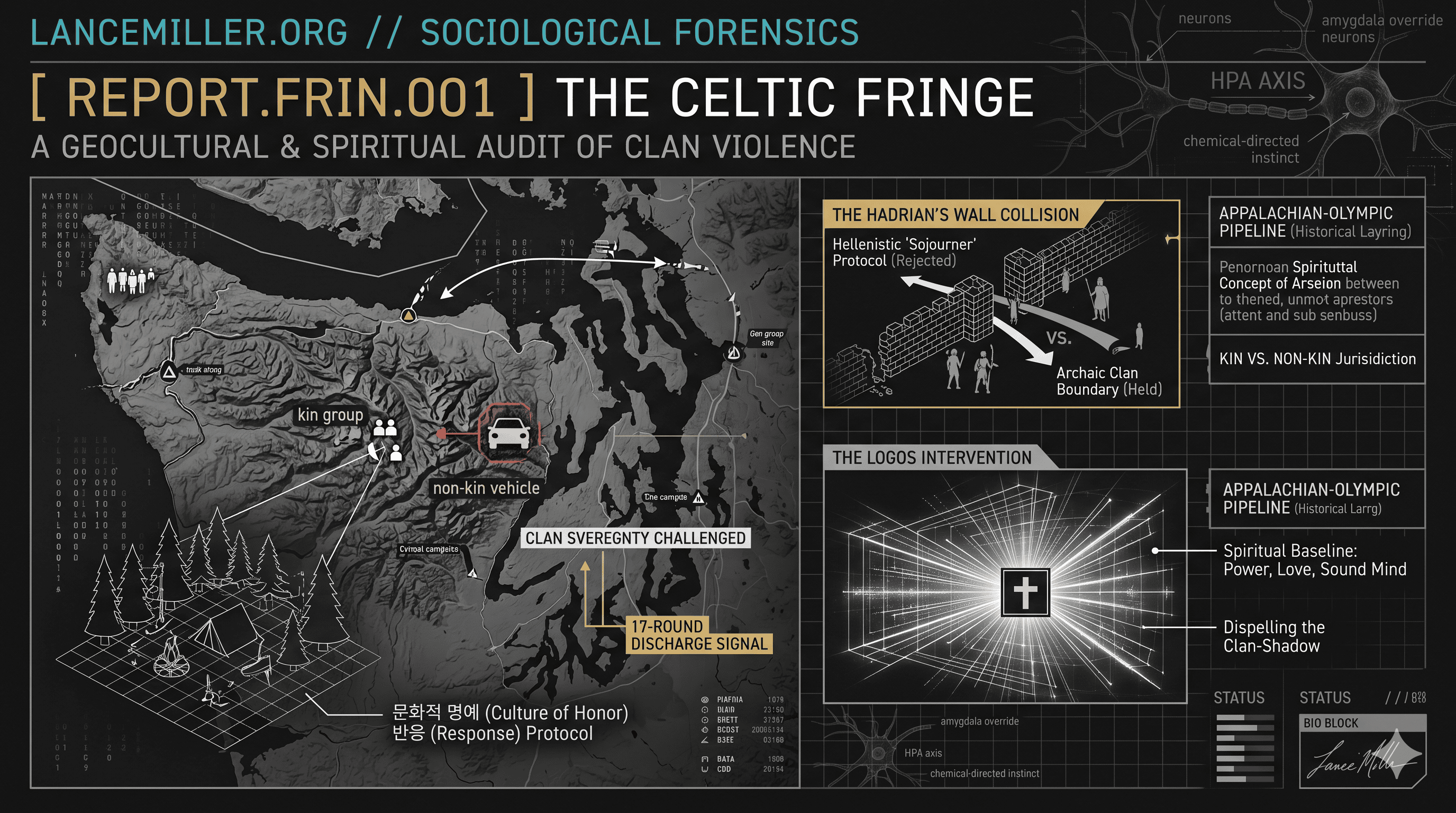
>> INCIDENT LOG: Child shot in Olympic National Forest; suspect arrested for assault.
The recent incident in the Olympic National Forest—where a kin group responded with immediate, total violence toward a group of non-kin for the simple act of driving into their territory—is more than an isolated police report. It is a modern confirmation of the enduring "Celtic Fringe" clan warfare and the "Culture of Honor" that still permeates the Olympic Peninsula. To understand why a family would fire seventeen rounds at a retreating vehicle, one must look at the deep-tissue historical and cultural layering of the region.
The recent incident in the Olympic National Forest—where a kin group responded with immediate, total violence toward a group of non-kin for the simple act of driving into their territory—is more than an isolated police report. It is a modern confirmation of the enduring "Celtic Fringe" clan warfare and the "Culture of Honor" that still permeates the Olympic Peninsula. To understand why a family would fire seventeen rounds at a retreating vehicle, one must look at the deep-tissue historical and cultural layering of the region.
// SYSTEM DIRECTORY: MODULE ACCESS
> I. The Historical & Cultural Framework
1. The Appalachian-Olympic Pipeline
The Olympic Peninsula possesses a distinct "Appalachian vibe" because it was the primary destination for the Great Out-migration of the early 20th century. Families from the hills of Kentucky, Tennessee, and West Virginia moved West to follow the timber. These Scots-Irish (Ulster Scots) populations were the first logging workers of Appalachia, and when they arrived in the Pacific Northwest, they brought a specific social architecture with them. They were a people born of the "New Frontier," possessing a worldview that prioritizes local autonomy and kinship over distant government authority.
2. The Celtic Fringe Legacy
The roots of this behavior go back centuries to the "Celtic Fringe"—specifically the lawless borderlands of Scotland and Ireland. These cultures were largely insulated from the Roman and Hellenistic values of the Mediterranean, which emphasized cosmopolitanism and the toleration of outsiders. Instead, they developed a "Clan" structure where the world is divided into two categories: Kin and Non-Kin. In this environment, the "family" (often involving intergenerational local ties and distant cousins) is the only reliable unit of protection.
3. The Mechanics of the "Culture of Honor"
This clan-type culture is hardwired—both emotionally and intellectually—to respond violently to threats against the kin group. In a "Culture of Honor," reputation is a physical asset. If a stranger enters your territory (in this case, a campsite), it is not seen as a navigational error; it is processed as a "probing" maneuver or a challenge to the clan's sovereignty. To respond with anything less than overwhelming force is seen as a sign of weakness that invites further victimization.
> II. The Analytical Takeaway
When we see this level of aggression in the modern day, we are witnessing a survival heuristic that predates the American legal system. While the modern world operates on "higher legal protocols" and the idea of state-mediated justice, the Clan-mindset operates on a primal, immediate protocol.
In this worldview, the "territory" is a sacred extension of the family unit. The extreme response seen in the news story confirms that the sociological ghost of the Celtic Fringe is still very much alive in the timber-rich isolation of the Peninsula. It is a world where the laws of the clan frequently override the laws of the land, and where "non-kin" are viewed with a suspicion that traces back a thousand years.
In this worldview, the "territory" is a sacred extension of the family unit. The extreme response seen in the news story confirms that the sociological ghost of the Celtic Fringe is still very much alive in the timber-rich isolation of the Peninsula. It is a world where the laws of the clan frequently override the laws of the land, and where "non-kin" are viewed with a suspicion that traces back a thousand years.
> III. The Great Collision: Hadrian’s Wall and the Rejection of the Sojourner
To view this incident merely as a breakdown of local law enforcement is to miss a 3,000-year-old tectonic struggle between two diametrically opposed visions of humanity. On one side stands the Celtic Fringe—the raw, unrefined energy of the clan. On the other stands the lineage of Hellenistic cosmopolitanism, a force of "light" in earthly affairs that seeks a trade-and-travel-intensive pan-culture. This cosmopolitanism is not a mere byproduct of secular trade; it is echoed deeply in the Law of Moses concerning the "sojourner" in your land.
This biblical mandate was never about simple altruism; it was a divine seed planted to demand an "anti-clan-ism". By commanding hospitality toward the stranger, the law broke the insular gravity of the tribe and generated the base elements of Hellenism—a system where the "other" is not an enemy, but a participant in a larger civilization. This ethos reached its zenith in the New Testament with the "good tidings to strangers," expanding the definition of kinship to include the entire human family.
This biblical mandate was never about simple altruism; it was a divine seed planted to demand an "anti-clan-ism". By commanding hospitality toward the stranger, the law broke the insular gravity of the tribe and generated the base elements of Hellenism—a system where the "other" is not an enemy, but a participant in a larger civilization. This ethos reached its zenith in the New Testament with the "good tidings to strangers," expanding the definition of kinship to include the entire human family.
THE ECHO OF THE WALL
Historically, the advance of this civilizing force met its most significant physical and spiritual check at Hadrian’s Wall. When the Scots-Irish ancestors held that line, they were halting a force that sought to impart the very benefits of Hellenistic and Roman civilization—the architecture of universal law and the sacred status of the traveler. Unbeknownst to the Romans, they were carrying the structural requirements for a world that honors the sojourner. By successfully resisting this integration, the Celtic Fringe cultures remained in a stasis of ancient clan warfare, preserving a worldview that sees the stranger as a threat.
Therefore, when 17 rounds are fired at a car for "trespassing" on a campsite in 2026, we are seeing the modern echo of Hadrian’s Wall. It is the rejection of the Hellenistic "sojourner" protocol in favor of the archaic clan boundary. The "ghost" in the Peninsula is not just a cultural quirk; it is a thousand-year-old refusal of the very civilizing virtues that allow a diverse, mobile society to function without violence.
Therefore, when 17 rounds are fired at a car for "trespassing" on a campsite in 2026, we are seeing the modern echo of Hadrian’s Wall. It is the rejection of the Hellenistic "sojourner" protocol in favor of the archaic clan boundary. The "ghost" in the Peninsula is not just a cultural quirk; it is a thousand-year-old refusal of the very civilizing virtues that allow a diverse, mobile society to function without violence.
> IV. The Logos and the Light: A Spiritual Dispelling of the Clan-Shadow
At the deepest level, this conflict is not merely sociological or historical—it is spiritual.
"In the beginning was the Word, and the Word was with God, and the Word was God."
— John 1:1 (ESV)
The Word, or the Logos, is the divine blueprint for order, truth, and the ultimate expansion of the human heart beyond the narrow walls of the clan. Jesus spoke clearly of this division:
"I have come into the world as light, so that whoever believes in me may not remain in darkness."
— John 12:46 (ESV)
The violence of territorial clan reactions is a manifestation of that darkness—a spiritual blindness that mistakes a wandering neighbor for a lethal enemy. It is a state where fear masquerades as strength and where the "reputation" of the clan becomes a false idol. This darkness produces a tragic paradox: a "stupidity" or "silliness" where a family destroys its own future and the safety of a child in a senseless defense of a temporary campsite. This is the horror and sadness of a life lived outside the Light of the Word.
The forces of darkness interlock the human experience in a cycle of suspicion and blood, but the Word of God was sent to break that cycle. God's Word generates ways of being that benefit us not only in high spiritual realms but in our most practical earthly affairs. It provides the "Light" that dispels the ancient, defensive shadows of the Celtic Fringe.
By embracing the "good tidings to strangers," we move from the archaic violence of the boundary to the peace of the open road. The Light does not just save souls; it civilizes the material world, transforming a "territory" into a community and a "clan" into a family of mankind. To walk in the Light is to finally step over Hadrian’s Wall and into the freedom for which we were designed.
The forces of darkness interlock the human experience in a cycle of suspicion and blood, but the Word of God was sent to break that cycle. God's Word generates ways of being that benefit us not only in high spiritual realms but in our most practical earthly affairs. It provides the "Light" that dispels the ancient, defensive shadows of the Celtic Fringe.
By embracing the "good tidings to strangers," we move from the archaic violence of the boundary to the peace of the open road. The Light does not just save souls; it civilizes the material world, transforming a "territory" into a community and a "clan" into a family of mankind. To walk in the Light is to finally step over Hadrian’s Wall and into the freedom for which we were designed.
> RELATED INTELLIGENCE DOSSIERS
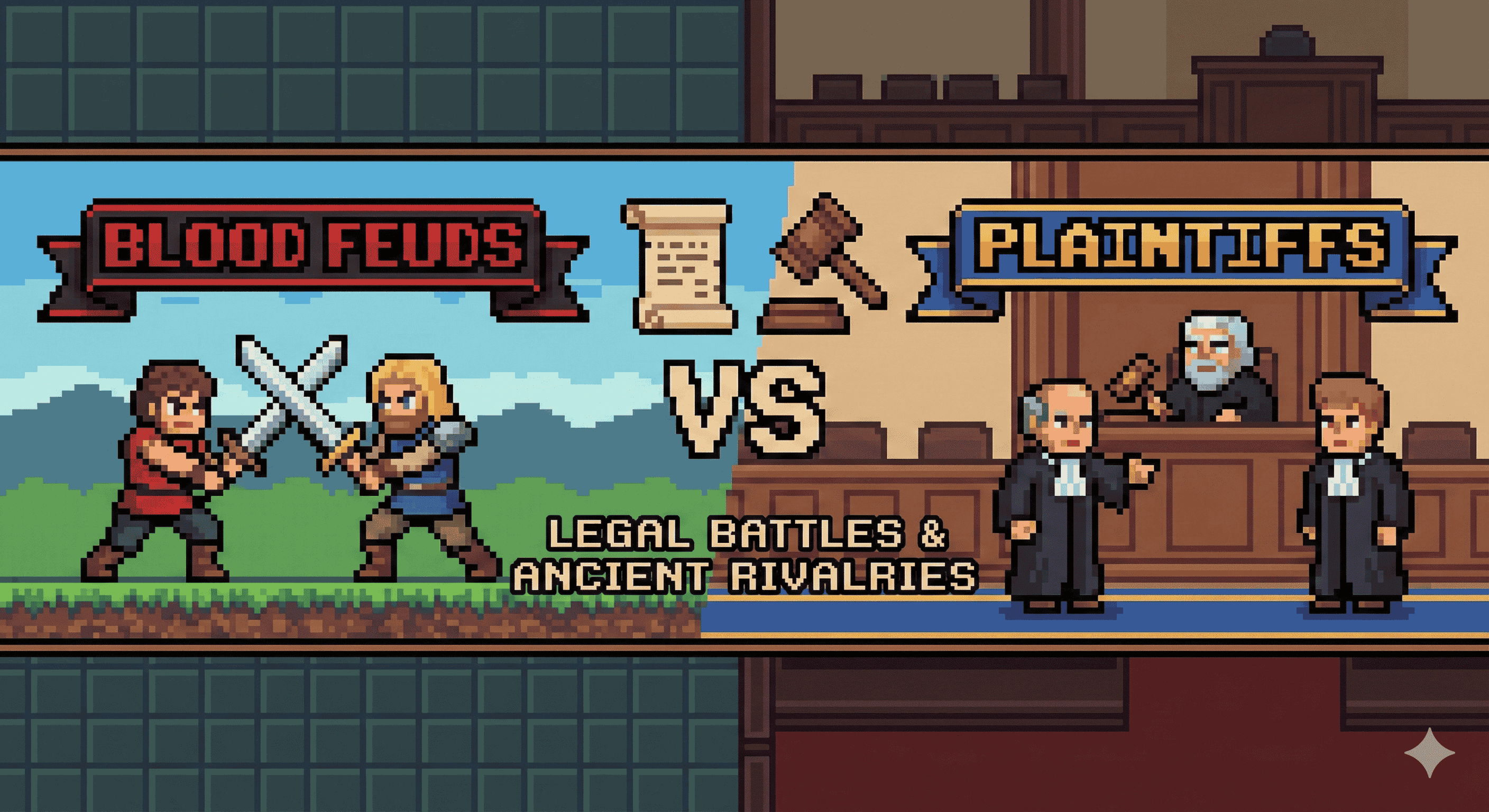
Social Analysis: Blood Feuds & The Modern Plaintiff. System analysis of retributive justice, the Archive Economy, and the weaponization of grievance vs. the Kingdom jurisprudence.
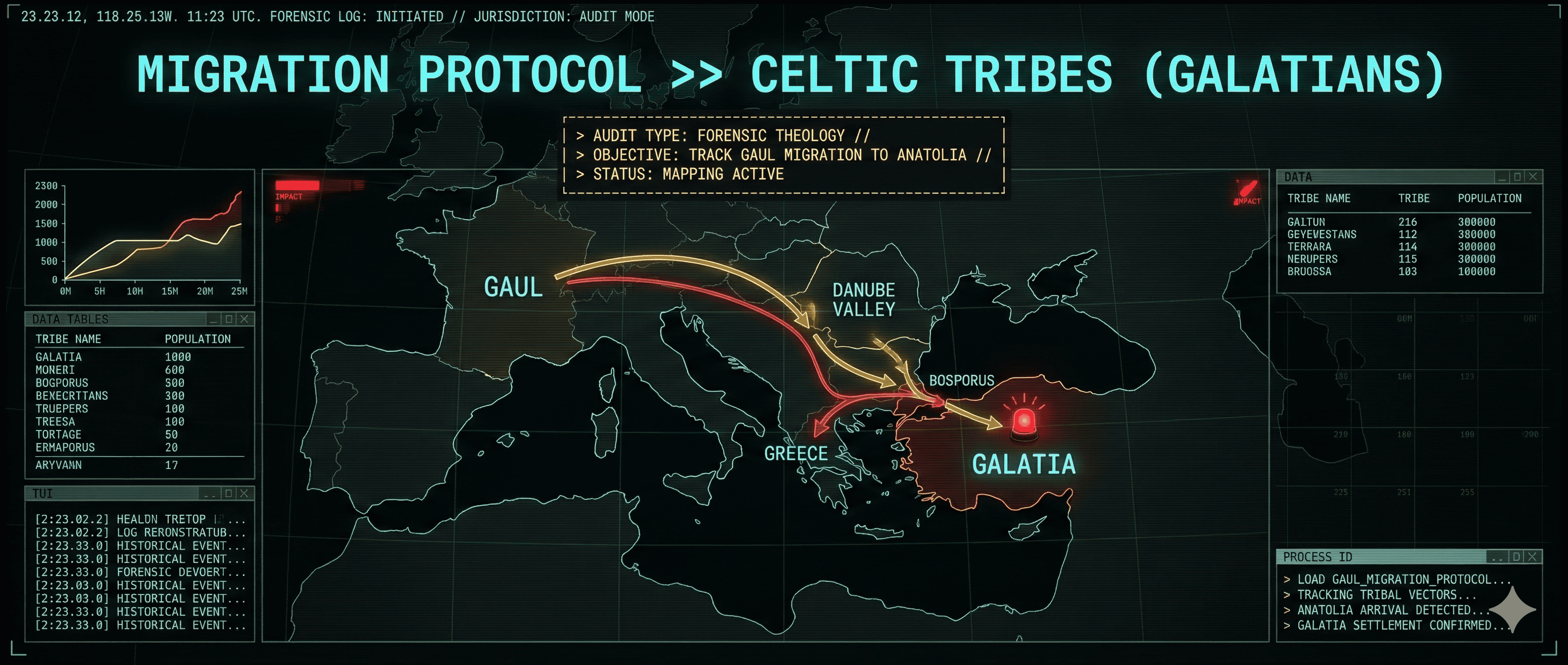
Forensic Theology: Celts, Galatians, and the New Testament. A tactical correction delivered to a specific ethnic group possessed by a unique socio-theological error.
> SYSTEM ARCHITECT

Lance Miller is the architect of lancemiller.org. His operational history includes a winter-over in Antarctica (Operation Deepfreeze '96, Congressional Medal), four years in the Alaskan fishing industry (Bering Sea, '99), and fighting the historic Biscuit Fire in the Siskiyou Mountains (2002). Holding a B.S. (2003), he later served as a Test Engineer on a technology team that won an Emmy Award (2008). Based in Seattle, he now merges Unix philosophy with theology to decode the Western Tradition.
[ X.COM PROFILE ]
[ X.COM PROFILE ]
[ TAP OPTIC TO CLOSE ]