OPERATIONAL CONTEXT: Attending your first Eastern Orthodox Divine Liturgy can feel like stepping into a different century. Stepping into Eastern Orthodoxy means leaving behind the modern paradigm of church as entertainment, emotional manipulation, or social club. If you are looking for an environment of quiet, stable strength—focused entirely on the objective reality of worship rather than the subjective feelings of the congregation—you will find it here. This document serves as a foundational guide to the theology, physical spatial layout, and initiation protocols of the Orthodox Church.
// SYSTEM DIRECTORY: MODULE ACCESS
> I. THE THEOLOGICAL CORE & SEVEN BELIEFS
Orthodoxy has never experienced the Western European Enlightenment or the rationalistic reductionism of the Reformation. It retains a deeply cosmic, multi-dimensional view of reality that refuses to market itself or bend to cultural shifts. It simply stands still and demands that the believer step up to meet it. This worldview is anchored in seven distinct beliefs that separate the Orthodox tradition from the rest of the Western Christian landscape.
1. Holy Tradition as Co-Equal to Scripture
While Protestantism operates on Sola Scriptura (Scripture alone) and Catholicism places the Magisterium as the final interpreter, Orthodoxy views Holy Tradition as a single, cohesive river of life. Scripture is not separate from tradition; it is the pinnacle of tradition. This includes the decrees of the Seven Ecumenical Councils, the Liturgy itself, the creeds, and the consensus of the early Church Fathers. You cannot cut Scripture out of the historical environment that birthed it.
2. Theosis and Christus Victor
Western Christianity often teaches salvation as a legal transaction: you are a guilty criminal, and Christ pays your fine. Orthodoxy rejects this legalistic reductionism (penal substitutionary atonement). Instead, they emphasize Christus Victor—Christ trampling down death by death, conquering demonic powers, and liberating humanity. Salvation is viewed as Theosis: a lifelong, transformative process of biological and spiritual union with God. Guided by the ancient patristic maxim, "God became man so that man might become god," Orthodoxy teaches that believers physically and spiritually absorb the uncreated energies of God to overcome mortality.
3. The Essence-Energies Distinction
This theological framework fuels their cosmic worldview. Orthodoxy separates God’s Essence (His inner, transcendent nature, which is completely unknowable and inaccessible to created beings) from His Energies (His attributes that pour out into creation, like His love, grace, light, and presence). Because of this, humans can truly encounter and be filled by the literal presence of God through His energies without crossing the boundary of becoming the Creator Himself.
4. Ancestral Sin vs. Original Sin
Most Western churches inherited St. Augustine’s view of "Original Sin," implying that every human inherits the literal guilt of Adam’s rebellion. Orthodoxy teaches Ancestral Sin. You did not inherit Adam's personal guilt; you inherited the consequences of his broken relationship with God—namely, physical death, a corrupted cosmos, and a distorted human nature prone to sin. Christ came not to appease an angry Father, but as a physician to heal a fatally diseased humanity.
5. Icons as Windows to the Unseen Realm
To an outsider, icons look like religious art. To the Orthodox, they are a fundamental profession of the Incarnation. Because God literally took physical flesh and blood in Jesus Christ, the physical world has been sanctified. Icons are not idols; they are testimonies that the unseen realm has intersected with our material world. In worship, an icon functions as a portal, reminding the believer that the saints, martyrs, and angelic hosts of the Divine Council are actively present in the room.
6. The Real, Mystery-Based Presence in the Eucharist
While many Protestant churches view communion as a symbolic memorial, and Roman Catholicism uses Aristotelian philosophy to define it precisely (Transubstantiation), Orthodoxy preserves the ancient stance: it is an inexplicable Holy Mystery. They firmly believe the bread and wine literally become the body and blood of Christ, but they refuse to utilize rationalistic formulas to explain how it happens. It is accepted in quiet, awe-filled faith.
7. Ascetic Discipline and Liturgical Fasting
Modern Western Christianity treats fasting as an optional lifestyle choice. Orthodoxy maintains strict, corporate, liturgical fasting cycles encompassing roughly half of every calendar year (including every Wednesday and Friday, Great Lent, and Advent). Believers cut out meat, dairy, oil, and alcohol. This discipline is not seen as "earning" salvation, but as an indispensable ascetic tool—training for the soul to subdue physical appetites, build spiritual stamina, and wage war against chaotic spiritual forces.
> II. SPATIAL LAYOUT & TEMPLE ARCHITECTURE
An Orthodox temple is physically laid out to mirror the ancient Tabernacle, structured into three distinct theological zones moving from west to east. The environment is dense, highly sensory, and intentionally formal.
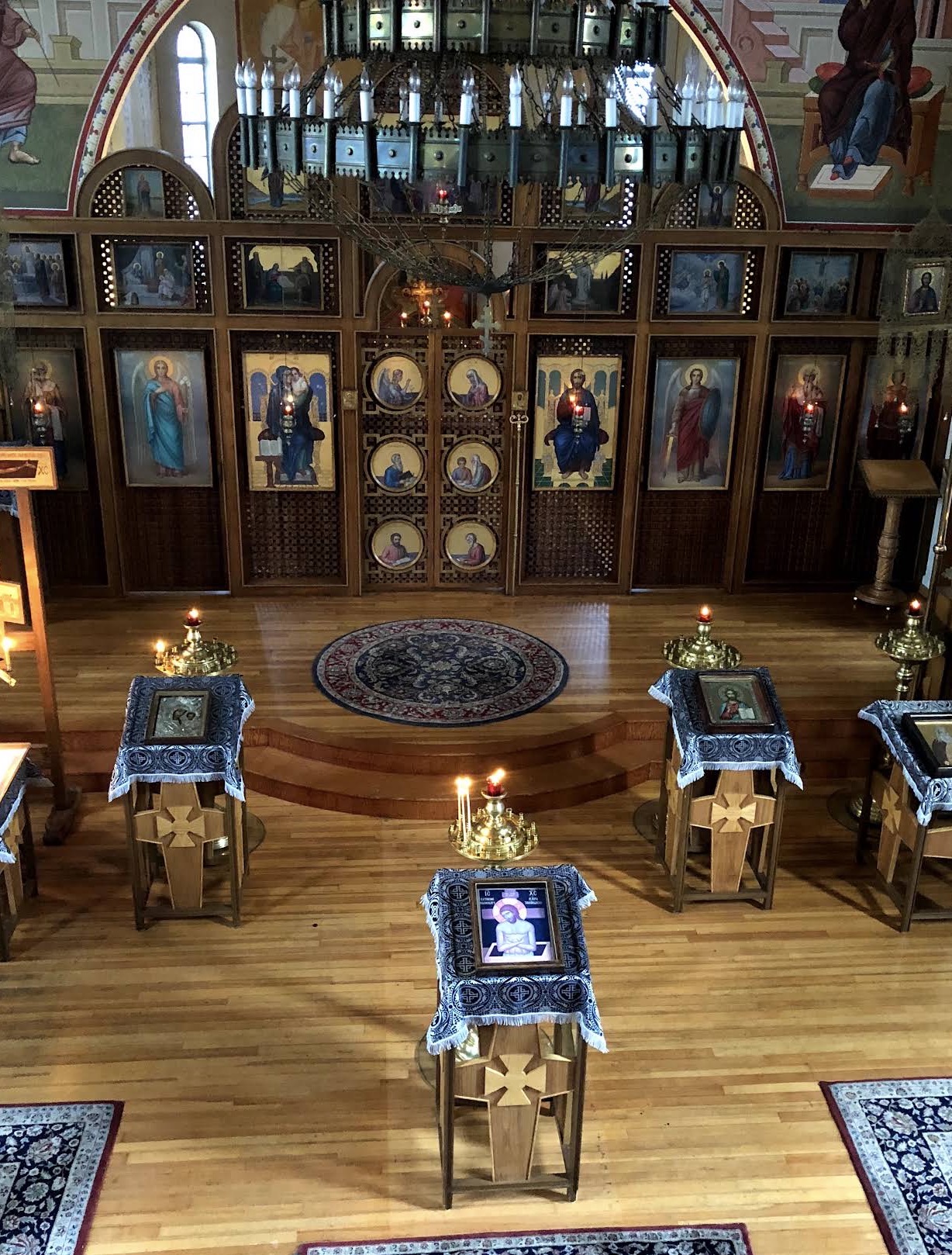
Standard Layout of an Orthodox Nave and Iconostasis
THE THREE ZONES
- The Narthex (The Entryway): The threshold between the secular world and the sacred space. When you first walk into a church, you are here. This is where people buy candles, leave coats, and transition into quiet reverence.
- The Nave (The Main Body): Where the congregation stands. In traditional architecture, the Nave represents the visible creation redeemed by Christ. There are very few pews; Orthodox Christians stand for worship to reflect an attitude of alert, focused service.
- The Sanctuary (The Altar): Located behind the large wall of icons (the Iconostasis). It represents the Holy of Holies, the unseen realm of God. Only the clergy and tonsured servers cross behind the Iconostasis through the Royal Doors or Deacon's doors.
> III. LITURGICAL FLOW & ETIQUETTE
The Divine Liturgy is highly structured, sung almost entirely a cappella by the choir, and broken into three distinct chronological movements. Worship here is an objective duty, not a concert. It demands stamina.
| Liturgical Sequence | Duration / Timing | Structural Focus |
|---|---|---|
| 1. Proskomedia (Liturgy of Preparation) |
Before public service | Occurs behind the Iconostasis. The priest quietly cuts the altar bread, pours wine into the chalice, and offers prayers for the living and the dead while the congregation arrives. |
| 2. Liturgy of the Catechumens | Approx. 45 minutes | Begins with the exclamation: "Blessed is the Kingdom..." Focuses on instruction. Features litanies, hymns, the Small Entrance (carrying the Gospel book), Epistle/Gospel readings, and the sermon. |
| 3. Liturgy of the Faithful | Approx. 45 minutes | Historically where unbaptized were dismissed. Contains the Great Entrance (carrying bread/wine to the altar), the Nicene Creed, and the Anaphora (Eucharistic prayer). Ends with communion and Antidoron distribution. |
VISITOR PROTOCOLS: ETIQUETTE & EXPECTATIONS
Orthodox etiquette is anchored in reverence, physical discipline, and spatial awareness. As a newcomer, your goal is quiet, unassuming observation.
Dress Code: Modesty and respect dominate. Business casual is the baseline (collared shirts, slacks, modest dresses). Avoid shorts and graphic tees.
Posture: Expect to stand for the 90-minute service. It is a physical sacrifice of presence. If fatigued, sitting on side benches is completely acceptable. Do not sit during the Gospel reading, the Great Entrance, or the Eucharistic Consecration.
Physical Actions: You will see people crossing themselves, bowing, and kissing icons. As an inquirer, you are under no obligation to mimic these actions. Standing quietly is respected.
The Communion Barrier: Only baptized and chrismated Orthodox Christians who have prepared through fasting and confession may receive the Eucharist. Do not join the line. However, at the end of the service, everyone is invited to kiss the cross and receive blessed bread (Antidoron) as a sign of hospitality.
Dress Code: Modesty and respect dominate. Business casual is the baseline (collared shirts, slacks, modest dresses). Avoid shorts and graphic tees.
Posture: Expect to stand for the 90-minute service. It is a physical sacrifice of presence. If fatigued, sitting on side benches is completely acceptable. Do not sit during the Gospel reading, the Great Entrance, or the Eucharistic Consecration.
Physical Actions: You will see people crossing themselves, bowing, and kissing icons. As an inquirer, you are under no obligation to mimic these actions. Standing quietly is respected.
The Communion Barrier: Only baptized and chrismated Orthodox Christians who have prepared through fasting and confession may receive the Eucharist. Do not join the line. However, at the end of the service, everyone is invited to kiss the cross and receive blessed bread (Antidoron) as a sign of hospitality.
> IV. Becoming a Catechumen
| Phase | Timeline | Objectives & Actions |
|---|---|---|
| 1. Inquiry | 1-3 Months | Attend services, observe the liturgy, and speak casually with the parish priest (Fr. Alexei) during coffee hour to express serious intent. |
| 2. The Catechumenate | 6 Months - 1 Year | Formally brought in as a "Learner." Attend catechism classes, study dogmas, learn prayer rules, and integrate into the parish's liturgical fasting life. |
| 3. Life Confession | Prior to Baptism | Prepare and deliver a comprehensive review of your past life, repenting of missteps and clearing the slate completely before entering the font. |
| 4. The Holy Mystery | Culmination | Received through full triple-immersion Baptism, followed immediately by Chrismation (anointing with holy oil) and the first Holy Communion. |
NEXT STEPS: INITIATION
If you plan to visit an Orthodox church, do not worry about signing up or announcing yourself beforehand. Simply walk in. Divine Liturgy typically begins at 9:30 AM on Sunday mornings (preceded by Hours at 9:10 AM). Stand near the middle or back, take in the icons, and experience the weight of the liturgy. Do not try to read along in a service book or analyze every word. Simply let the objective weight of the ancient rhythm wash over you.