// SYSTEM DIRECTORY: MODULE ACCESS
> I. Executive Summary: The Deuteronomy 32 Doctrine
The standard historical view of the divided monarchy often focuses purely on political instability, taxation disputes, and economic shifts following the death of Solomon. However, utilizing the "Divine Council" framework established by the late Dr. Michael Heiser, these historical events transform into a series of strategic, high-stakes military operations against the "lords of the nations".
At the core of this analysis is the Cosmic Geography established in Deuteronomy 32:8–9. In this ancient worldview, the world is divided into territorial allotments: Israel is Yahweh’s exclusive, sovereign portion, while the other nations of the earth were assigned to lesser elohim—the Divine Council. These assigned entities subsequently rebelled, effectively establishing themselves as the hostile "gods" of the foreign nations. Therefore, the history of Israel is not just a human story of kings and conquests; it is a meticulous record of territorial incursions, spiritual breaches, and calculated "Reversing Babel" maneuvers orchestrated by the Most High.
At the core of this analysis is the Cosmic Geography established in Deuteronomy 32:8–9. In this ancient worldview, the world is divided into territorial allotments: Israel is Yahweh’s exclusive, sovereign portion, while the other nations of the earth were assigned to lesser elohim—the Divine Council. These assigned entities subsequently rebelled, effectively establishing themselves as the hostile "gods" of the foreign nations. Therefore, the history of Israel is not just a human story of kings and conquests; it is a meticulous record of territorial incursions, spiritual breaches, and calculated "Reversing Babel" maneuvers orchestrated by the Most High.
> II. Dossier: The Rogue Elohim & The Solomonic Breach
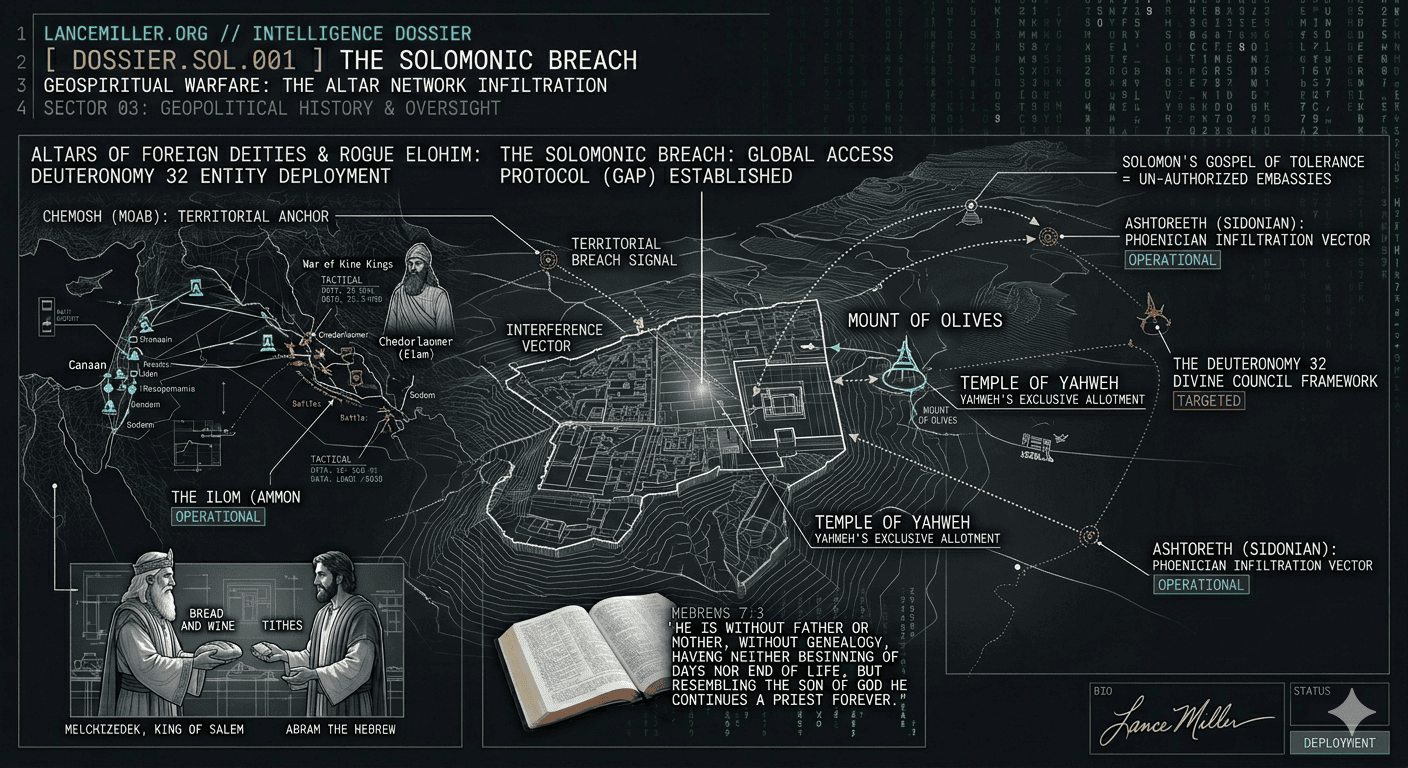
The national crisis did not begin with military weakness; it began with a high-level security breach during the administration of King Solomon. According to the records in 1 Kings 11:5–8, Solomon did not merely practice passive religious tolerance. He granted Strategic Invasion of Allotment to foreign powers by building cultic infrastructure for them. These entities are identified within the biblical text as ontologically real elohim who breached their geographic boundaries to infiltrate Yahweh’s exclusive portion.
Targeted Asset Profiles
| Entity / Asset | Origin / Domain | Tactical Objective & Impact |
|---|---|---|
| Ashtoreth (Astarte) | Sidonian / Phoenician | The counterpart to Ishtar. Her infiltration utilized diplomatic marriages to secure an operational base—a "high place"—in Jerusalem, establishing a foothold directly challenging the Tabernacle’s holiness code. |
| Milcom & Molech | Ammonite | Linguistically linked to the root mlk (King). They demanded the "tax" of the next generation through cultic infanticide. Solomon established their high place on the Mount of Olives (the "Mount of Corruption"). Geographically, this is less than a mile east of Mount Moriah, creating a direct visual and spiritual blockade against the Temple. |
| Chemosh | Moabite | The "Abomination of Moab," confirmed independently by the Mesha Stele as a territorial entity capable of granting military victory through herem (total devotion/destruction). His presence neutralized Israel's spiritual defenses by tethering the nation’s destiny to dark, localized pagan pacts. |
By building these "high places" (bamot) directly adjacent to the capital, Solomon created unauthorized access points—hostile embassies—that remained active and operational for nearly 300 years. This effectively jammed the spiritual "signal" of Israel, compromising the structural integrity of the nation.
> III. Geospiritual Restructuring: The Divided Kingdom
The violent division of the kingdom following Solomon's death was the physical manifestation of this spiritual clutter. When the spiritual seal of Yahweh’s exclusive portion was broken, the land underwent a severe "geospiritual" restructuring.
The Jeroboam Protocol: Chokepoint Containment
Jeroboam I, the first king of the splintered Northern Kingdom of Israel, faced a severe tactical dilemma: if his citizens continued to travel south to Yahweh’s HQ in Jerusalem for the annual festivals, he would inevitably lose political and economic control.
His solution was a masterful piece of spiritual engineering: the creation of a "counter-cult" using The Golden Calves at two highly strategic locations—Dan and Bethel.
His solution was a masterful piece of spiritual engineering: the creation of a "counter-cult" using The Golden Calves at two highly strategic locations—Dan and Bethel.
- Bethel: Located a mere 10 miles north of Jerusalem, acting as a direct interception point on the main southern arterial road.
- Dan: Located at the extreme northern border, nestled at the foot of Mount Hermon, capturing the northern populace before they could migrate south.
This wasn't just a new religion; it was a dual-perimeter containment field. It "trapped" worship within localized, paganized iconography common to Egypt and Canaan, effectively inviting territorial spirits to re-occupy the heartland of the Northern Kingdom.
The Ahab-Jezebel Escalation: Total Displacement
Where Jeroboam compromised through syncretism, King Ahab—generations later—attempted Total Displacement. Under the direct influence of his wife Jezebel, who was the daughter of the high priest of Ethbaal (King of Tyre), the North was subjected to a formal "de-territorialization."
Ahab built a massive temple dedicated to Baal in the capital city of Samaria. Located on a central, easily defensible hill, Samaria became the new administrative center for the rogue elohim. By doing this, Ahab was effectively declaring the Northern Kingdom to be a province of Phoenician divine powers rather than Yahweh’s protected portion.
Ahab built a massive temple dedicated to Baal in the capital city of Samaria. Located on a central, easily defensible hill, Samaria became the new administrative center for the rogue elohim. By doing this, Ahab was effectively declaring the Northern Kingdom to be a province of Phoenician divine powers rather than Yahweh’s protected portion.
>> OPERATIONAL POSTURE
Elijah operating as a kinetic agent in hostile territory
> IV. The Elijah Itinerary: A Strategic Counter-Incursion
In this landscape of hostile occupation and compromised borders, the prophet Elijah serves as a Special Envoy. He is a kinetic agent dispatched to execute targeted strikes to reclaim Yahweh’s legal rights over the land. His ministry follows a precise, deliberate "Divine Council" itinerary.
1. Mount Carmel: The Direct Assault (1 Kings 18)
Geographical Context: Mount Carmel is a formidable coastal mountain range rising roughly 1,700 feet, physically jutting out into the Mediterranean Sea and overlooking the vast Jezreel Valley. Crucially, it formed the geographic and cultural border between Israel and Phoenicia (Jezebel's homeland and Baal’s "home turf").
This was a deliberate power encounter. By calling down fire from heaven, Yahweh publicly shamed Baal—the deity heralded in Ugaritic texts as the "Rider on the Clouds" who supposedly possessed total control over storms and lightning. Yahweh literally "stole" Baal's thunder on his own border, proving in front of the entire council that the territorial council member was a fraud.
This was a deliberate power encounter. By calling down fire from heaven, Yahweh publicly shamed Baal—the deity heralded in Ugaritic texts as the "Rider on the Clouds" who supposedly possessed total control over storms and lightning. Yahweh literally "stole" Baal's thunder on his own border, proving in front of the entire council that the territorial council member was a fraud.
2. The Retreat to the Boundary (1 Kings 19:1–3)
Following the strike at Carmel, Elijah faced a lethal threat from Jezebel—the literal "seed of the serpent" representing the entrenched interests of the rebel elohim. Elijah executed a tactical withdrawal, fleeing overland over 100 miles south to Beersheba.
Beersheba was the southernmost outpost of Judah, the gateway to the desolate Negev desert. Elijah was retreating to the absolute limit of "Yahweh’s land," marking the extent of sovereign territory before the chaos of the deep desert began.
Beersheba was the southernmost outpost of Judah, the gateway to the desolate Negev desert. Elijah was retreating to the absolute limit of "Yahweh’s land," marking the extent of sovereign territory before the chaos of the deep desert began.
3. The Wilderness: Chaos Territory (1 Kings 19:4–8)
Leaving the borders of Israel entirely, Elijah plunged deep into the wilderness. In the cosmic geography worldview, the deep desert is "chaos territory," the domain of Azazel, the demonic, and death.
Sustained supernaturally by a loyal member of the Divine Council (the Angel), Elijah retraced the ancient steps of the Exodus, marching for 40 days and 40 nights through hostile, unforgiving terrain to prepare for an audience with the Head of the Council.
Sustained supernaturally by a loyal member of the Divine Council (the Angel), Elijah retraced the ancient steps of the Exodus, marching for 40 days and 40 nights through hostile, unforgiving terrain to prepare for an audience with the Head of the Council.
4. Mount Horeb: The Council Chambers (1 Kings 19:9–18)
Geographical Context: Mount Horeb (Sinai) is a massive granite peak rising over 7,400 feet in the southern Sinai Peninsula, isolated and imposing.
In the Ancient Near East, it was universally understood that the gods convened their councils on the summits of cosmic mountains. When Elijah arrived at Horeb and heard the "low whisper" (the qol dmamah daqqah), he wasn't just experiencing a moment of inner peace—he was standing at attention in the Presence of the Divine Council.
Here, Elijah received his operational orders, a three-part hit list to restructure the geopolitical landscape: Anoint Hazael over Syria, Jehu over Israel, and Elisha as his successor. By commanding the anointing of Hazael—a foreign, non-Israelite king—Yahweh asserted absolute jurisdiction, proving that He, not the rebel gods, controls the destiny of foreign nations. This was a definitive "Reversing Babel" maneuver.
In the Ancient Near East, it was universally understood that the gods convened their councils on the summits of cosmic mountains. When Elijah arrived at Horeb and heard the "low whisper" (the qol dmamah daqqah), he wasn't just experiencing a moment of inner peace—he was standing at attention in the Presence of the Divine Council.
Here, Elijah received his operational orders, a three-part hit list to restructure the geopolitical landscape: Anoint Hazael over Syria, Jehu over Israel, and Elisha as his successor. By commanding the anointing of Hazael—a foreign, non-Israelite king—Yahweh asserted absolute jurisdiction, proving that He, not the rebel gods, controls the destiny of foreign nations. This was a definitive "Reversing Babel" maneuver.
> V. Conclusion: Reversing Hermon
The operational impact of Elijah’s counter-incursion echoes across centuries, ultimately culminating in the ministry of the "Second Elijah" (John the Baptist) and the direct actions of Jesus Christ.
The Hermon Target: Mount Hermon is a towering, snow-capped massif reaching over 9,200 feet, dominating the visual landscape of the northern theater where the borders of modern-day Syria, Lebanon, and Israel meet. In Second Temple Jewish literature (like the Book of Enoch), Mount Hermon was notoriously identified as the specific geographic site where the rebellious "Watchers" (Genesis 6) originally descended to corrupt humanity. It was ground zero for the cosmic rebellion.
When Jesus takes Peter, James, and John to a "high mountain" for the Transfiguration—which Heiser and many topographical scholars identify as the slopes of Mount Hermon—He does not go alone. He is met on the summit by Moses (the Lawgiver) and Elijah (the Baal-slayer).
The Hermon Target: Mount Hermon is a towering, snow-capped massif reaching over 9,200 feet, dominating the visual landscape of the northern theater where the borders of modern-day Syria, Lebanon, and Israel meet. In Second Temple Jewish literature (like the Book of Enoch), Mount Hermon was notoriously identified as the specific geographic site where the rebellious "Watchers" (Genesis 6) originally descended to corrupt humanity. It was ground zero for the cosmic rebellion.
When Jesus takes Peter, James, and John to a "high mountain" for the Transfiguration—which Heiser and many topographical scholars identify as the slopes of Mount Hermon—He does not go alone. He is met on the summit by Moses (the Lawgiver) and Elijah (the Baal-slayer).
THE EVICTION NOTICE
This was not merely a glowing photo opportunity for the disciples. By appearing in glorified state on the summit of Mount Hermon with Elijah, the ultimate kinetic agent who had previously humiliated the council of Baal, Jesus was staging a calculated, highly aggressive provocation. He marched directly to the rebel elohim's historic headquarters and served them a formal eviction notice. It was the declaration that the turf war was ending, and the global reclamation of the disinherited nations had officially begun.
> SYSTEM ARCHITECT




Lance Miller is the architect of lancemiller.org. His operational history includes a winter-over in Antarctica (Operation Deepfreeze '96, Congressional Medal), four years in the Alaskan fishing industry (Bering Sea, '99), and fighting the historic Biscuit Fire in the Siskiyou Mountains (2002). Holding a B.S. (2003), he later served as a Test Engineer on a technology team that won an Emmy Award (2008). Based in Seattle, he now merges Unix philosophy with theology to decode the Western Tradition.
[ X.COM PROFILE ]
[ X.COM PROFILE ]
[ TAP OPTIC TO CLOSE ]