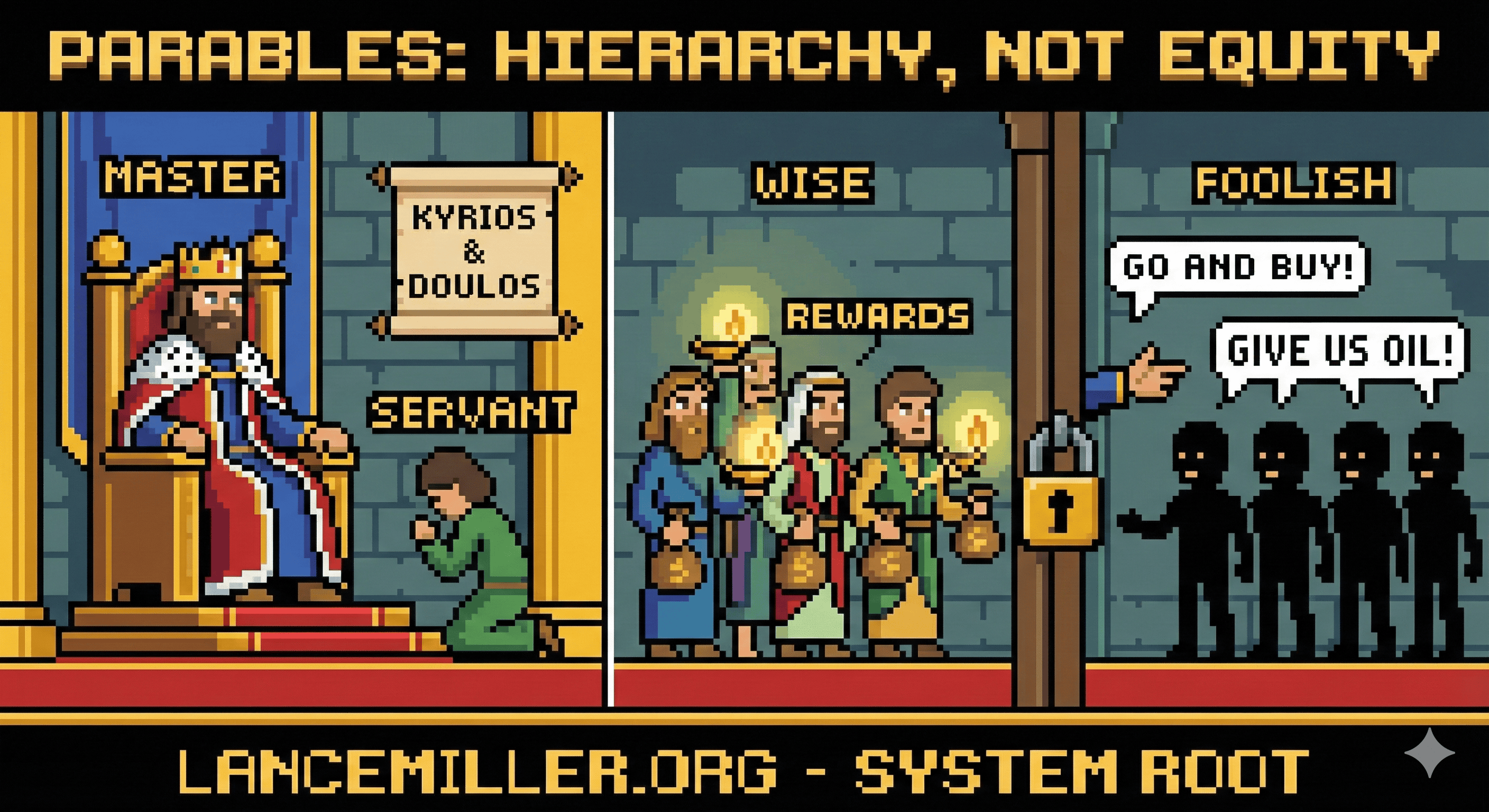
Parables: Hierarchy, Not Equity
On Masters, Servants, and the Implied Values of the Son of Man
[ ⚡ DEPLOY OPERATIONS CAPITAL ]
// SUSTAIN THE SIGNAL //
PROJECT OVERVIEW:
This project examines specific components of two parables delivered by the Son of Man (Jesus) in the Gospel of Matthew. While traditional theology focuses on the ultimate eschatological message, this analysis isolates specific narrative devices—specifically the roles of masters and servants, and the distribution of resources among the wise and foolish.
Primary Thesis: The text reveals two distinct takeaways regarding the Kingdom of Heaven: the acceptance of the master/slave dynamic as a legitimate authority structure, and the rejection of "equity" or communistic sharing in favor of individual responsibility and exclusion.
Primary Thesis: The text reveals two distinct takeaways regarding the Kingdom of Heaven: the acceptance of the master/slave dynamic as a legitimate authority structure, and the rejection of "equity" or communistic sharing in favor of individual responsibility and exclusion.
// I. THE SINLESS MASTER: A STUDY OF HIERARCHY
In Matthew 24, the Son of Man utilizes an analogy that places Himself in a position of supreme authority. To understand the weight of this comparison, we must strip away modern English softenings and look at the original language used in the Greco-Roman context.
"Who then is the faithful and wise servant, whom his master has set over his household... But if that wicked servant says to himself, ‘My master is delayed,’ and begins to beat his fellow servants... the master of that servant will come on a day when he does not expect him... and will cut him in pieces."
Matthew 24:45-51 (ESV)
| ROLE | KOINE GREEK DEFINITION |
|---|---|
| The Master Kyrios / κύριος |
In the first-century context, this denoted one who had power, authority, and ownership over people and property. |
| The Servant Doulos / δοῦλος |
In Greco-Roman usage, this is not a hired employee or a contract worker; it is a slave. A doulos was property, wholly subject to the will of the kyrios. |
THE IMPLICATION:
The Son of Man, whom believers acknowledge is without sin, voluntarily adopts the persona of the Kyrios (slave owner) in this teaching. He holds the power of life and death, with the authority to "cut him in pieces" for failure to perform duties.
If the institution of slavery or the ownership of one man by another were inherently sinful in the eyes of the Son of Man, this analogy would be morally incompatible with His nature. Instead, the text treats the master/slave relationship as an unremarkable, accepted reality of the time. The moral weight is placed on faithfulness within the structure, not the abolition of the structure itself.
See also: Blood Feuds & Plaintiffs for analysis on how modern society rejects this vertical authority in favor of horizontal grievance.
If the institution of slavery or the ownership of one man by another were inherently sinful in the eyes of the Son of Man, this analogy would be morally incompatible with His nature. Instead, the text treats the master/slave relationship as an unremarkable, accepted reality of the time. The moral weight is placed on faithfulness within the structure, not the abolition of the structure itself.
See also: Blood Feuds & Plaintiffs for analysis on how modern society rejects this vertical authority in favor of horizontal grievance.
// II. THE REJECTION OF EQUITY (MATTHEW 25)
"And the foolish said to the wise, ‘Give us some of your oil, for our lamps are going out.’ But the wise answered, saying, ‘Since there will not be enough for us and for you, go rather to the dealers and buy for yourselves.’"
Matthew 25:8-9 (ESV)
THE CRISIS OF SCARCITY:
When the bridegroom arrives at midnight, the foolish virgins realize their lack. Their demand is one of communistic equity: "Give us some of your oil." They appeal to the collective good, expecting those with surplus to subsidize those with a deficit.
This demand mirrors the modern "Covetousness Vector," where lack of preparation transforms into a moral demand for the resources of others. (See: The Covetousness Vector & Political Firewall).
This demand mirrors the modern "Covetousness Vector," where lack of preparation transforms into a moral demand for the resources of others. (See: The Covetousness Vector & Political Firewall).
THE RESPONSE: MOCKERY OF "GO AND BUY"
The wise virgins do not share. They engage in what modern critics might call "hoarding." Their response is a sharp refusal.
We must analyze the nature of this advice. It is midnight. The shops are closed. There are no "dealers" awake. The wise virgins know this. The suggestion to "go and buy" is not a helpful tip; it is a dismissal. It serves as a rhetorical way of saying, "You are out of luck, fool."
We must analyze the nature of this advice. It is midnight. The shops are closed. There are no "dealers" awake. The wise virgins know this. The suggestion to "go and buy" is not a helpful tip; it is a dismissal. It serves as a rhetorical way of saying, "You are out of luck, fool."
THE CONSEQUENCE:
The Son of Man does not step in to redistribute the oil. He does not rebuke the wise for their selfishness. On the contrary, the "hoarders" are rewarded.
When the foolish return, the door is shut. The Master disowns them completely: "Truly, I say to you, I do not know you."
When the foolish return, the door is shut. The Master disowns them completely: "Truly, I say to you, I do not know you."
// III. FINAL TAKEAWAYS
SYSTEM SUMMARY:
Through these two parables, a distinct profile of the Son of Man's economy emerges, contrasting sharply with modern ideals of equity and egalitarianism:
1. The Legitimacy of Hierarchy: The Son of Man operates as a Kyrios (Master). The historical reality of slavery is used as the foundational metaphor for His relationship with humanity, carrying no negative connotation in the text. It validates a structure of absolute authority and submission.
2. The Rejection of Shared Outcomes: The Kingdom is not an equity economy. Wisdom results in abundance that is not shared with the foolish. The request for redistribution is met with refusal and mockery. Rewards are exclusive to those who possess the "oil" of preparedness.
1. The Legitimacy of Hierarchy: The Son of Man operates as a Kyrios (Master). The historical reality of slavery is used as the foundational metaphor for His relationship with humanity, carrying no negative connotation in the text. It validates a structure of absolute authority and submission.
2. The Rejection of Shared Outcomes: The Kingdom is not an equity economy. Wisdom results in abundance that is not shared with the foolish. The request for redistribution is met with refusal and mockery. Rewards are exclusive to those who possess the "oil" of preparedness.
> SYSTEM ARCHITECT




Lance Miller is the architect of lancemiller.org. His operational history includes a winter-over in Antarctica (Operation Deepfreeze '96, Congressional Medal), four years in the Alaskan fishing industry (Bering Sea, '99), and fighting the historic Biscuit Fire in the Siskiyou Mountains (2002). Holding a B.S. (2003), he later served as a Test Engineer on a technology team that won an Emmy Award (2008). Based in Seattle, he now merges Unix philosophy with theology to decode the Western Tradition.
[ X.COM PROFILE ]
[ X.COM PROFILE ]