SITREP: STRIKE ZONE HORMUZ & THE DOMESTIC FALLOUT
A Forensic Intelligence Report on the Gulf Blockade and the American Economic Reality
// I. MARITIME INTELLIGENCE: THE "SMART BLOCKADE"
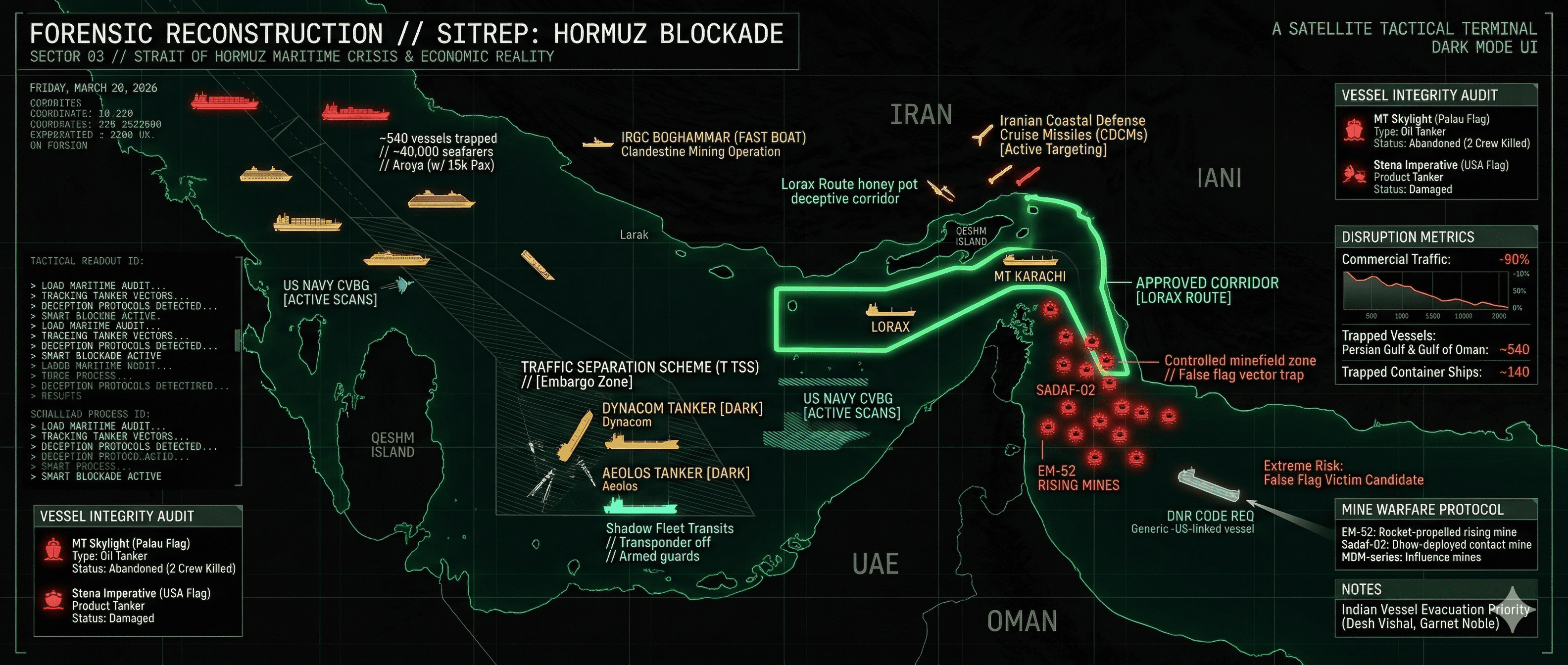
As of March 20, 2026, the Strait of Hormuz is experiencing the most severe maritime crisis since the 1980s "Tanker War." While the strait is not physically blocked by sunken vessels, it is currently operating under a "smart blockade" enforced by Iranian forces. This operation utilizes a combination of kinetic strikes, electronic warfare, and a selective "approved corridor" system.
Current intelligence suggests that commercial traffic has plummeted by 90%. Approximately 150 to 540 tankers are currently "awaiting orders" or trapped behind the chokepoint (depending on whether the wider Gulf of Oman is included in the count). Furthermore, the blockade monitors or traps approximately 140 to 150 container ships along with dozens of additional tankers. Roughly 40,000 seafarers are estimated to be trapped on vessels across the Persian Gulf and Gulf of Oman. The Indian government has actively prioritized the evacuation of 22 vessels, including the Desh Vishal and Garnet Noble, in order to secure their national energy interests.
Current intelligence suggests that commercial traffic has plummeted by 90%. Approximately 150 to 540 tankers are currently "awaiting orders" or trapped behind the chokepoint (depending on whether the wider Gulf of Oman is included in the count). Furthermore, the blockade monitors or traps approximately 140 to 150 container ships along with dozens of additional tankers. Roughly 40,000 seafarers are estimated to be trapped on vessels across the Persian Gulf and Gulf of Oman. The Indian government has actively prioritized the evacuation of 22 vessels, including the Desh Vishal and Garnet Noble, in order to secure their national energy interests.
| Vessels Recently Attacked or Stranded (Partial List) | |||
|---|---|---|---|
| Vessel Name | Flag | Type | Status/Result |
| MT Skylight | Palau | Oil Tanker | Abandoned (2 crew killed) |
| MKD VYOM | Marshall Islands | Oil Tanker | Abandoned (1 crew killed) |
| MV Mayuree Naree | Thailand | Bulk Carrier | Abandoned/On Fire |
| Zefyros | Malta | Oil Tanker | Set Ablaze/Abandoned |
| Safesea Vishnu | Marshall Islands | Oil Tanker | Set Ablaze/Abandoned |
| Stena Imperative | USA | Product Tanker | Damaged |
| Parimal | Palau | Chemical Tanker | Abandoned (Captain missing) |
| One Majesty | Japan | Container Ship | Minor Damage |
| Aroya | Saudi Arabia | Cruise Ship | Stranded (w/ 15,000 pax in region) |
TACTICAL ASSET: THE GREEK "SHADOW" FLEET
Greek shipowners, who currently control nearly 30% of the world’s tanker fleet, represent the primary risk-takers in the region. Driven by extraordinary freight rates peaking at $440,000–$500,000 per day, certain owners continue transits while Western majors like Maersk and MSC have fully rerouted. The Dynacom Group (led by George Prokopiou) is identified as the most active, with at least 5–10 Dynacom-linked tankers (including Dynacom and C Traders vessels) transiting the strait since March 1st. Aeolos Management (Embiricos Family) is also reported to be maintaining operations for select high-value contracts. Tactical doctrine for these vessels includes transiting with AIS (Automatic Identification System) disabled ("dark"), navigating without transponders, and hiring private armed guards to avoid drone targeting.
// II. IRANIAN MINE WARFARE & DECEPTION PROTOCOLS
Despite U.S. strikes that successfully sank 16 Iranian minelayers on March 10, Iran retains 80–90% of its small-boat fleet, which remains highly capable of rapid, clandestine mining. Identified mine threats include:
- Sadaf-02: Contact mines (moored) that are easy to deploy from small dhows.
- EM-52: Rocket-propelled "rising" mines that sit on the seabed and launch at a hull's acoustic signature.
- MDM-series: Sophisticated magnetic and acoustic influence mines.
FALSE FLAG WARNING: THE "LORAX" ROUTE
The vessel Lorax (and recently the Pakistani tanker Karachi) utilized an unconventional route, hugging the Iranian coastline between Larak and Qeshm Islands rather than the standard Traffic Separation Scheme (TSS) near Oman. This route is an Iran-sanctioned "political corridor," allowing friendly or neutral nations (Pakistan, India, China) to pass through waters easily monitored by land-based coastal defense cruise missiles (CDCMs).
There is a high probability that the Lorax route functions as a selective trap. By permitting a few "approved" ships through, Iran creates a deceptive "honey pot" effect. If a Western-linked ship attempts to follow the Lorax without prior IRGC approval, they enter a "controlled environment" where Iran has already mapped the exact mine-free path. Iran uses "Boghammar" fast boats to drop bottom-dwelling mines directly in the wake of an approved vessel. Therefore, the route used by the Lorax at 0800 hours may be lethal by 1200 hours for any ship lacking the correct digital "handshake" or transponder code. Navigating this route without explicit Iranian coordination is assessed as Extreme Risk.
There is a high probability that the Lorax route functions as a selective trap. By permitting a few "approved" ships through, Iran creates a deceptive "honey pot" effect. If a Western-linked ship attempts to follow the Lorax without prior IRGC approval, they enter a "controlled environment" where Iran has already mapped the exact mine-free path. Iran uses "Boghammar" fast boats to drop bottom-dwelling mines directly in the wake of an approved vessel. Therefore, the route used by the Lorax at 0800 hours may be lethal by 1200 hours for any ship lacking the correct digital "handshake" or transponder code. Navigating this route without explicit Iranian coordination is assessed as Extreme Risk.
// III. GEOPOLITICAL POLARITY & THE COLD WAR OF LOGISTICS
This maritime polarity represents a "Cold War" of logistics. Nations like Pakistan, India, and Turkey have secured "political understandings" with Tehran to use the Iranian coastal corridor (the Lorax Route). This creates a bifurcated ocean: a "Safe Zone" for those willing to recognize Iranian hegemony, and a "Strike Zone" for those adhering to the US-led embargo. In Washington, this serves to isolate the current Republican-majority's "Maximum Pressure" stance. By allowing neutral vessels to pass while intentionally striking US-linked or "compliant" ships, Iran is attempting to prove that the US Navy can no longer guarantee the safety of global commons. This represents a direct optical strike against the "Peace through Strength" platform, aiming to demonstrate to US voters that DC’s foreign policy is the primary driver of their domestic economic pain.
| Current Alignment Profile of Notable Assets | |||
|---|---|---|---|
| Vessel Name | Owner / Mgmt | Vested Interest | National Alliance Polarity |
| MT Karachi | Pakistan Nat. Shipping | Pakistan / State Energy | Neutral/Pragmatic: Pakistan maintains a "green light" from Tehran, signaling a shift toward regional autonomy away from US security umbrellas. |
| Zefyros | Dynacom (Greek) | Greece / EU Energy | Transactional: Greek owners leverage high risk-premiums ($500k/day), operating in defiance of Western "red zone" advisories. |
| ONE Majesty | Ocean Network Express | Japan / Global Retail | Pro-US/G7: Japan is actively seeking US Navy escorts, viewing the blockade as a direct assault on the rules-based order. |
| Safeen Prestige | Transmar (UAE) | UAE / Regional Trade | Pro-US/Anti-Iran: UAE interests are currently aligned with the Republican-led push for a decisive military solution to restore Jebel Ali’s throughput. |
| Star Gwyneth | Star Bulk (Greek) | Marshall Is. / Bulks | Western-Aligned: Despite the flag, the management follows strict Western insurance protocols currently being breached for profit. |
// IV. THE U.S. VOTER’S LIVED EXPERIENCE (MARCH 2026 VS. SEPT 2025)
The Strait of Hormuz crisis has evolved from a localized naval skirmish into a foundational rift in global geopolitics, directly impacting the material well-being of the United States domestic population. For the American voter, the "real world" metric is defined by the refrigerator and the gas pump.
Grocery Prime Staples
Beef (Ground/Chuck): In September 2025, beef prices were already elevated due to a cyclical contraction of the cattle herd. As of March 20, 2026, retail beef is averaging $6.12/lb, up from $5.85/lb six months ago (a 4.6% increase). This is driven by high "farm-level" costs and the rising price of diesel for transport.
Eggs (Grade A, Large): In a rare positive shift, egg prices have collapsed relative to the 2024–25 Avian Flu spikes. In September 2025, a dozen eggs cost approximately $2.90; today, they average $2.05 (a 29% decrease). This provides a psychological "anchor" of stability despite other rising costs.
Overall Food-at-Home: Grocery inflation is currently tracking at 3.1% annually. While not a "hyper-inflationary" spike, the cumulative effect means the average family is spending roughly $45 more per month on the same basket of goods than they were in late 2025.
Grocery Prime Staples
Beef (Ground/Chuck): In September 2025, beef prices were already elevated due to a cyclical contraction of the cattle herd. As of March 20, 2026, retail beef is averaging $6.12/lb, up from $5.85/lb six months ago (a 4.6% increase). This is driven by high "farm-level" costs and the rising price of diesel for transport.
Eggs (Grade A, Large): In a rare positive shift, egg prices have collapsed relative to the 2024–25 Avian Flu spikes. In September 2025, a dozen eggs cost approximately $2.90; today, they average $2.05 (a 29% decrease). This provides a psychological "anchor" of stability despite other rising costs.
Overall Food-at-Home: Grocery inflation is currently tracking at 3.1% annually. While not a "hyper-inflationary" spike, the cumulative effect means the average family is spending roughly $45 more per month on the same basket of goods than they were in late 2025.
CLIMATE POLICY REVERSAL VS. WAR RISK INFLATION
In early 2025, "Climate Inflation" was a dominant narrative due to SEC-mandated emissions reporting and fuel-standard penalties, which added an estimated $0.12 to $0.18 per gallon to logistics costs. Following the 2025 policy shifts and executive orders to "unleash" energy, these specific regulatory surcharges have been largely neutralized.
However, the Strait of Hormuz Crisis has effectively replaced "Regulatory Inflation" with "War Risk Inflation." While the cost of compliance went down, the cost of insurance and crude went up. Crude oil has crossed $100/barrel, meaning the financial "dividend" from ending climate regulations hasn't reached the consumer's wallet because it was absorbed by the geopolitical risk premium. Consequently, gasoline is 15% more expensive due to the Hormuz blockade.
However, the Strait of Hormuz Crisis has effectively replaced "Regulatory Inflation" with "War Risk Inflation." While the cost of compliance went down, the cost of insurance and crude went up. Crude oil has crossed $100/barrel, meaning the financial "dividend" from ending climate regulations hasn't reached the consumer's wallet because it was absorbed by the geopolitical risk premium. Consequently, gasoline is 15% more expensive due to the Hormuz blockade.
Public Safety & Lived Reality
National crime data through early 2026 shows a continued downward trend in violent crime. Homicides in major hubs like DC and Denver are down 40% compared to the 2021 peaks. Despite this statistical improvement, 60% of voters still rank "Safety" as a top concern. This perception is increasingly tied to "Cyber-Safety" and "Infrastructure Security" as Iranian-linked hacking groups actively target US water and power utilities in retaliation for the Gulf strikes. Your neighborhood is statistically safer than it was three years ago.
National crime data through early 2026 shows a continued downward trend in violent crime. Homicides in major hubs like DC and Denver are down 40% compared to the 2021 peaks. Despite this statistical improvement, 60% of voters still rank "Safety" as a top concern. This perception is increasingly tied to "Cyber-Safety" and "Infrastructure Security" as Iranian-linked hacking groups actively target US water and power utilities in retaliation for the Gulf strikes. Your neighborhood is statistically safer than it was three years ago.
SUMMATION VERDICT
As of March 20, 2026, the US voter’s lived experience is "Stagnant and Tense." Compared to six months ago, you are paying significantly less for eggs but marginally more for meat. The "Material Reality" is a tug-of-war: the removal of domestic climate regulations has lowered the floor of energy costs, but the Middle East war has raised the ceiling, leaving the average voter in a state of high-cost neutrality.
> SYSTEM ARCHITECT




Lance Miller is the architect of lancemiller.org. His operational history includes a winter-over in Antarctica (Operation Deepfreeze '96, Congressional Medal), four years in the Alaskan fishing industry (Bering Sea, '99), and fighting the historic Biscuit Fire in the Siskiyou Mountains (2002). Holding a B.S. (2003), he later served as a Test Engineer on a technology team that won an Emmy Award (2008). Based in Seattle, he now merges Unix philosophy with theology to decode the Western Tradition.
[ X.COM PROFILE ]
[ X.COM PROFILE ]
[ TAP OPTIC TO CLOSE ]