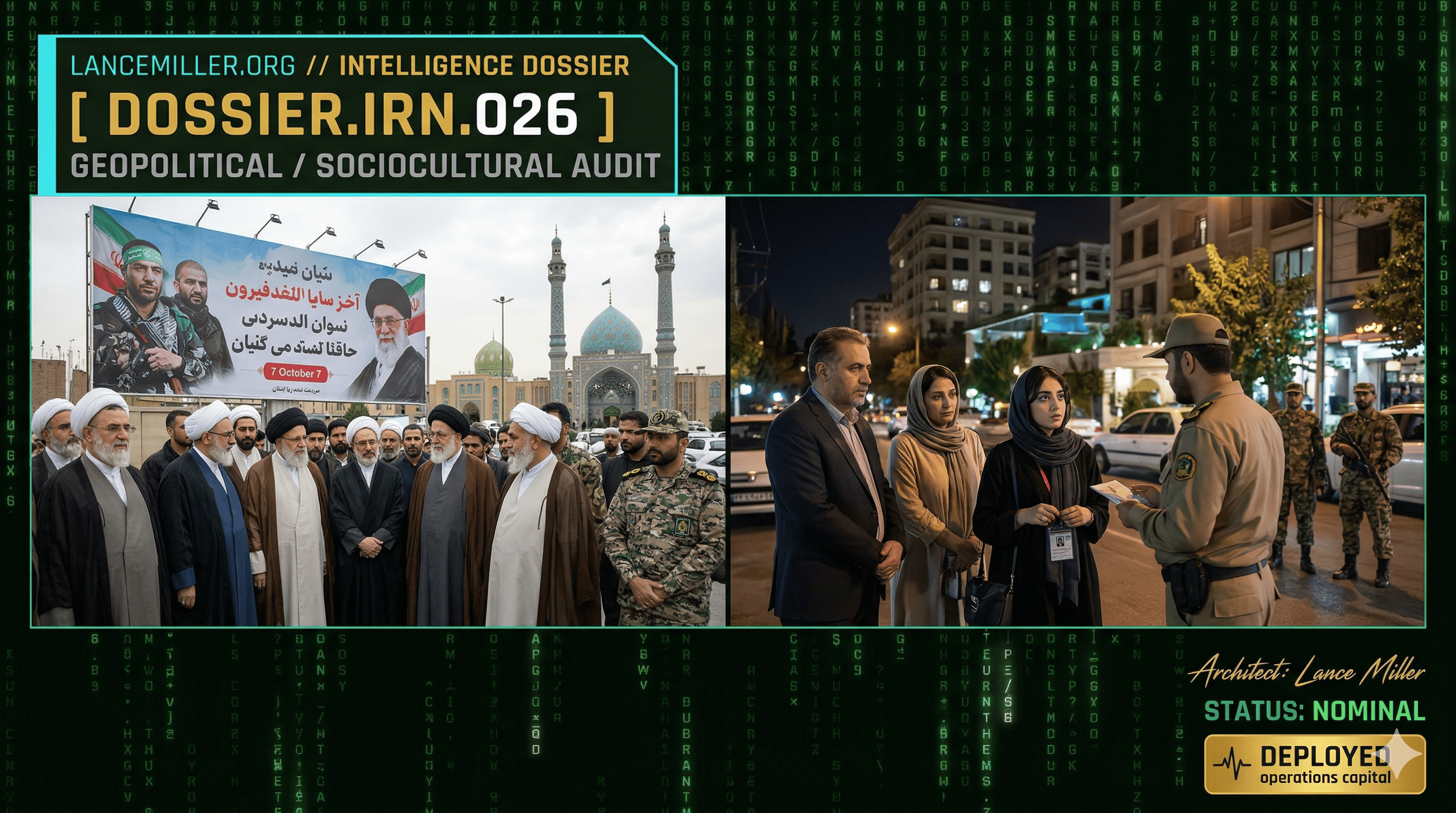
The historical trajectory of Iran since 1970 represents one of the most complex sociological and geopolitical case studies in the modern era. Defined by a persistent dualism between a revolutionary clerical establishment and a cosmopolitan, educated urban populace, the nation has functioned as a site of intense cultural contestation for over half a century. This report examines the evolution of these two primary groups—the Nezam (the ruling establishment) and the Mellat (the nation’s urban professional class)—analyzing their cultural profiles, the history of their internal friction, and the culminating events of the mid-2020s that led to the collapse of the traditional clerical order.
> I. Sociopolitical Terminology and the Concept of the Nezam
To understand the Iranian state, one must first address the terminology surrounding its governance. While the term "Islamic Regime" is common in Western discourse, academic and professional geopolitical analysis typically employs the term Nezam (The System) or the "Ruling Establishment". The Nezam refers to a complex web of unelected institutions, security apparatuses, and clerical bodies that operate under the principle of Velayat-e Faqih (Guardianship of the Islamic Jurist). This structure blends republican elements, such as an elected parliament and presidency, with the absolute authority of a Supreme Leader (the Rahbar), who oversees foreign and domestic policy and controls the judiciary and security forces.
This dual structure has historically created a "lopsided" system of power, where revolutionary and Islamic values consistently override democratic practices. The Nezam is not merely a political government but an ideological project aimed at maintaining a Shi'ite interpretation of Islam as the foundation of society. Conversely, the Mellat represents the citizenry, particularly the urban middle and upper classes, who have frequently found themselves at odds with the Nezam's restrictive social codes and regional ambitions.
This dual structure has historically created a "lopsided" system of power, where revolutionary and Islamic values consistently override democratic practices. The Nezam is not merely a political government but an ideological project aimed at maintaining a Shi'ite interpretation of Islam as the foundation of society. Conversely, the Mellat represents the citizenry, particularly the urban middle and upper classes, who have frequently found themselves at odds with the Nezam's restrictive social codes and regional ambitions.
> II. Cultural Profile of the Urban Professional Class
The urban professional and educated populace of Iran is characterized by a high degree of Westernization, intellectual curiosity, and a lifestyle that often exists in direct opposition to state-mandated piety. This demographic is primarily concentrated in Tehran—specifically the northern districts—as well as other major urban hubs like Isfahan, Shiraz, and Mashhad.
The Evolution of Urban Modernity
Modernity in Iran traces its roots back to the 1960s and 1970s, during the reign of Mohammad Reza Shah Pahlavi. The Shah’s modernization projects fostered a growing urban middle class defined by white-collar employment and the expansion of higher education. This era established a cultural template for the hip and glamorous Tehran of the 1970s, a cosmopolitan outpost of European-educated artists, poets, and professionals. While the 1979 Revolution attempted to erase these Western markers, the cultural memory of this period persisted, evolving into a modern secularism among today's youth.
Leisure and Lifestyle: The Alpine Escape
For the urban upper-middle class, the Alborz Mountains serve as both a physical and a cultural escape. Skiing is a hallmark of this demographic's lifestyle. The Dizin Ski Resort, established in the 1960s, remains the largest in the Middle East and is favored for its high altitude and quality snow. In resorts like Shemshak and Darbandsar, the urban elite socializes in designer ski gear, effectively creating a space where the state’s moral policing is less visible.
| Feature | Dizin Ski Resort | Shemshak Ski Resort |
|---|---|---|
| Altitude | 2,700m to 3,600m | 2,550m to 3,000m+ |
| Accessibility | 65km-100km from Tehran | 57km from Tehran |
| Target Demographic | Intermediate/Intermediate | Advanced/Expert |
| Social Atmosphere | Lively weekend hub | Cosmopolitan, expert-focused |
| Historical Origin | Reign of Mohammad Reza Shah | Mid-20th Century (1949/1959) |
Beyond the slopes, the urban lifestyle is centered on modern amenities. In North Tehran, residents live in upmarket condominiums with gardens and swimming pools, hidden behind high walls to maintain a private secular existence. This "double life" is a core psychological component of the urban experience: a public performance of piety for the state and a private existence of authenticity.
Cafes, Arts, and Intellectual Life
The absence of traditional Western nightlife, such as bars and nightclubs, has led to the proliferation of a sophisticated cafe and art gallery scene. In downtown Tehran, "gallery hopping" on Fridays has become a cultural movement for the upper-middle class. These spaces function as vital social hubs where young intellectuals discuss art, philosophy, and politics over tea and pastries.
The Tehran Museum of Contemporary Art (TMoCA) remains a symbolic center of this cultural life. Built in 1977, it houses the largest collection of modern art in the Middle East, including works by Andy Warhol, Francis Bacon, and Mark Rothko. Despite political upheavals, these works have remained the property of the museum, and the institution continues to draw large crowds of young art lovers.
The Tehran Museum of Contemporary Art (TMoCA) remains a symbolic center of this cultural life. Built in 1977, it houses the largest collection of modern art in the Middle East, including works by Andy Warhol, Francis Bacon, and Mark Rothko. Despite political upheavals, these works have remained the property of the museum, and the institution continues to draw large crowds of young art lovers.
EDUCATION AND THE CRISIS OF THE "MIDDLE-CLASS POOR"
Education is the primary driver of status and mobility for the urban class. Iran’s literacy rates are remarkably high, and in cities like Tehran, it is common to encounter a population dominated by engineers, doctors, and PhD holders. However, this intellectual prosperity exists within a politically and economically repressive state. In the early 2020s, a new sociological group emerged: the "middle-class poor," defined by downward mobility amid socioeconomic precarity, where even the highly educated struggle with inflation and housing insecurity.
This economic desperation has fueled a massive "brain drain." By 2024, the number of Iranian students studying abroad hit a record high of 110,000, with over 70% reporting no intention of returning. This exodus reflects a lack of faith in the country's trajectory and a preference for freedom and personal dignity over the slogans of the Nezam.
This economic desperation has fueled a massive "brain drain." By 2024, the number of Iranian students studying abroad hit a record high of 110,000, with over 70% reporting no intention of returning. This exodus reflects a lack of faith in the country's trajectory and a preference for freedom and personal dignity over the slogans of the Nezam.
| Education and Migration Statistics | Data Point |
|---|---|
| Total Students Abroad (2024) | 110,000 |
| Growth Rate (4 years) | Doubled from 60,000 |
| Intent to Return | < 30% |
| Leading Destination | Turkey (30,000 students) |
| Professional Emigration (5 yrs) | 25,000 (Doctors, Engineers, PhDs) |
Views on Israel and Westernization
While the Nezam maintains an ideology of "Death to Israel," public sentiment in the urban class is often markedly different. Pro-Israeli sentiments have surfaced on Iranian social media as a form of symbolic defiance against the government’s foreign policy. Many urban Iranians view the state’s support for regional proxies as a waste of national resources that should be spent on domestic infrastructure. This demographic is highly Westernized in its consumption of media, fashion, and social values, frequently expressing an "unabated creativity" that mirrors European urban cultures.
> III. Cultural Profile of the Islamic Regime (The Nezam)
The Nezam maintains its power through a highly organized loyalist base recruited from specific segments of the population. This group views themselves as the "defenders of the revolution" and is characterized by a deep ideological commitment to Shi'ite Islam and the preservation of the clerical state.
Recruitment and Demographics
Recruitment into the regime’s security apparatus, specifically the Islamic Revolutionary Guard Corps (IRGC) and its paramilitary branch, the Basij, primarily targets the traditionally religious, tribal, and rural backgrounds of society. Historically, the Basij consisted of volunteers from poor backgrounds who were motivated by patriotism and a religious love of martyrdom, particularly during the Iran-Iraq War.
In the modern era, recruitment has become more transactional. The regime offers official benefits—such as preferential places at universities, government jobs, and subsidized bank loans—to those who demonstrate loyalty. This has created a "state-within-a-state," where members of the IRGC and Basij dominate the economy through massive conglomerates like Khatam al-Anbia, which controls sectors ranging from energy to telecommunications.
In the modern era, recruitment has become more transactional. The regime offers official benefits—such as preferential places at universities, government jobs, and subsidized bank loans—to those who demonstrate loyalty. This has created a "state-within-a-state," where members of the IRGC and Basij dominate the economy through massive conglomerates like Khatam al-Anbia, which controls sectors ranging from energy to telecommunications.
Social and Residential Hubs
The primary hubs of the loyalist base are religious and administrative centers.
- Qom: As the center of Shi'ite Muslim seminaries, Qom is the ideological heart of the Nezam. Here, loyalists such as Basij members man checkpoints and engage in nightly patrols as a religious duty.
- Mashhad: A major religious destination and the birthplace of many senior clerics, including Ali Khamenei.
- South Tehran: In contrast to the liberal north, South Tehran is more traditional, where shopping occurs in the bazaar and street food consists of meat kebabs rather than trendy cafe fare.
- University Hubs: The regime maintains its own educational institutions, such as Imam Hossein University and Baqiyatallah University, which serve as training grounds for the next generation of ideological leaders.
Lifestyle and Social Values
The lifestyle of the loyalist base is defined by family-oriented activities and religious observance. Their leisure time often revolves around visiting family, attending religious festivities, and spending time in mosques. Unlike the urban modernists, their social life is integrated with the state’s religious calendar. A core part of their "duty" is morality policing—enforcing the hijab, staffing checkpoints in parks, and suppressing dissident gatherings.
> IV. Timeline of Contestation and Conflict (1979–Present)
The relationship between the Nezam and the Mellat has been defined by a cycle of repression and resistance, with cultural markers like the hijab serving as primary flashpoints.
The Early Revolution and Hijab Mandates (1979–1983)
Following the 1979 Revolution, the clerical leadership quickly moved to consolidate power. While women had made serious strides into education and employment under the Shah, their rights were trampled upon by the new regime. The mandatory hijab was introduced as a core tenet of the Islamic identity of the new state. This was met with early protests, but the regime utilized the Iran-Iraq War (1980–1988) to crush dissent under the guise of national unity.
The Reformist Interlude (1997–2005)
The presidency of Mohammad Khatami marked a period where the middle class became the principal site for imagining social change. During this "Reform Era," Iranian cinema and arts decisively shifted focus to the everyday experiences of urban life—family tensions, generational divides, and the desire for greater freedom. However, the unelected bodies of the Nezam, specifically the Guardian Council, ultimately stifled these reform efforts, leading to deep public disillusionment.
The Era of Major Uprisings (2009–2026)
In the 21st century, the frequency and intensity of protests against the regime escalated as the gap between state and society widened.
- The Green Movement (2009): Triggered by allegations of corruption in the presidential election, this movement saw millions of Iranians in the streets of Tehran. The Basij militia gained international notoriety for its violent suppression of these protests.
- Economic and Social Protests (2017–2020): A series of protests sparked by fuel prices and mismanagement evolved into broader anti-government movements.
- Woman, Life, Freedom (2022–2023): Sparked by the death of Mahsa Jina Amini in the custody of the morality police, this movement focused on the mandatory hijab but quickly became a call for the total overthrow of the Nezam.
- The January 2026 Uprising: Following a period of hyperinflation and the failure of diplomacy, mass protests erupted across 200 cities. This uprising was the largest since 1979 and was met with unprecedented lethal force.
| Protest Movement | Year | Estimated Casualties/Stats | Primary Conflict Marker |
|---|---|---|---|
| Green Movement | 2009 | Hundreds killed, thousands arrested | Election Integrity |
| "Woman, Life, Freedom" | 2022 | ~500 killed, 20,000+ arrested | Hijab Laws/Amini Death |
| Executions (2024) | 2024 | 972 executions | Political Dissent/Drug Charges |
| January 2026 Protests | 2026 | 2,500 to 5,000 killed | Economic/Regime Change |
| Arrests (Dec 2025-Jan 2026) | 2026 | 53,000 people arrested | Civil Disobedience |
> V. Special Section: October 7, 2023, and the Internal Iranian Reaction
The Hamas-led attack on Israel on October 7, 2023, served as a "litmus test" for state-society relations in Iran. The response of the Nezam stood in "stark contrast" to that of the general public.
The Regime’s Narrative: The Axis of Resistance
For Supreme Leader Ali Khamenei and the IRGC, October 7 was seen as a "symbolic and strategic victory" in a generational struggle against Israel and the United States. The regime promptly voiced support for Hamas, erecting celebratory billboards in Tehran within hours of the attack. This support is rooted in the constitutional principle of "support for the oppressed," which the Nezam considers a part of its core identity rather than a mere policy choice.
The Public Sentiment: Defiance and Resource Frustration
The Iranian public’s reaction was markedly different from that in other Muslim nations. Rather than extensive pro-Palestine protests, many Iranians engaged in "symbolic acts of defiance" against the state's narrative.
- Stadium Protests: At Azadi Stadium in Tehran, fans booed during a minute of silence for Gaza and protested against the display of Palestinian flags.
- Slogans: The slogan "Neither Gaza, nor Lebanon, my life for Iran" resurfaced, reflecting a deep frustration with the government's allocation of scarce resources to foreign proxies while domestic poverty increased.
- Sociological Root: Sociologists trace this divergence to "war fatigue." Having lived through the devastating eight-year Iran-Iraq War, the general population favors diplomacy over the militancy favored by the hardline elite.
> VI. Escalation to War: Operations Midnight Hammer and Epic Fury
The geopolitical tensions following the October 7 attack and Iran’s continued nuclear enrichment led to a series of escalating military interventions by the United States and Israel in 2025 and 2026.
Operation Midnight Hammer (June 2025)
In June 2025, a limited but highly effective campaign was launched against Iran’s nuclear infrastructure. "Operation Midnight Hammer" utilized 30,000-pound "massive ordnance penetrator" (MOP) bombs to strike facilities at Fordow and Natanz. The strikes decimated enrichment and metallurgy facilities at Isfahan, dealing what the Trump administration described as an "obliterating" blow to the nuclear program. However, the International Atomic Energy Agency (IAEA) noted that while the program was damaged, the "nuclear grievance" it created within the regime only hardened their resolve to survive.
Operation Epic Fury and the Death of the Ayatollah (2026)
On February 28, 2026, a full-scale military conflict began. This campaign, named "Operation Epic Fury," was characterized by a "massive, overwhelming attack across all domains of warfare," striking over 1,000 targets in the first 24 hours.
- Elimination of the Supreme Leader: On the first day of the war, a joint U.S.-Israeli airstrike targeted and killed Supreme Leader Ayatollah Ali Khamenei. His office in central Tehran was described as "bombed-out".
- Infrastructure Destruction: The strikes were described as "pulverizing," resulting in the total destruction of Iran’s airports and ports. Kharg Island, responsible for the majority of Iran’s oil exports, was also struck, crippling the national economy.
- Internal Response: The IRGC took a "wartime lead," decentralizing command to allow mid-ranking officers to make decisions independently to ensure the regime's survival.
| Military Campaign | Date | Key Objectives/Outcomes |
|---|---|---|
| Midnight Hammer | June 2025 | Destruction of Fordow, Natanz, and Isfahan nuclear sites |
| Epic Fury | Feb 28, 2026 | Elimination of Ali Khamenei; destruction of Navy and Missile production |
| Roaring Lion | Feb-Mar 2026 | Decapitation of secondary leadership (Netanyahu-led operation) |
> VII. Special Ending Section: Diaspora and Global Reaction
The world greeted the news of the Ayatollah’s death and the onset of the war with a mixture of "jubilation, anger, and trepidation". The reaction of the Iranian diaspora, estimated at over 4 million people worldwide, was particularly fractured.
The Celebration of the Fallen Leader
In major diaspora hubs such as Los Angeles, London, and Paris, thousands of Iranians took to the streets to celebrate. Footage circulated of Iranians performing a dance in the style of Donald Trump to the song "YMCA" as a token of appreciation for the strikes that killed Khamenei. Many viewed the assassination not as an endorsement of war itself, but as a "rare opportunity to escape decades of repression". Monarchist forces in New York and Paris rallied for the return of Reza Pahlavi, waving the Lion and Sun flags of the pre-1979 era.
The Joyless Dissent: Fear of Ruin
Conversely, many Iranians in North America and Europe expressed "righteous anger" and despondency. While they rejected the rule of the velayat-e-faqih, they were traumatized by the sight of their homeland being reduced to ruin. There was a widespread fear that the war would leave Iran "poorer, hungrier, and more frightened," resulting in a "liberated ruin" rather than a democratic state. This group criticized Western anti-war protesters who held images of Khamenei, viewing them as "signaling virtue" while ignoring the suffering of Iranians inside the country.
The Internal Stalemate: Mojtaba Khamenei and the IRGC
Inside Iran, the loyalist base remained committed to the survival of the system. Hardliners held nightly mourning ceremonies for Khamenei even as bombs fell. The Assembly of Experts moved to elect Mojtaba Khamenei as the new Supreme Leader. As the 56-year-old son of the late Ayatollah and a close ally of the IRGC, Mojtaba represents a shift toward a harder, more militaristic line.
The conflict has left the Iranian people in a state of precariousness. While the top leadership was decapitated, the security apparatus—comprised of tens of thousands of IRGC and Basij forces—remains intact and ready to fight for the regime's survival. The urban modern class, while longing for change, now faces the dual threat of state-led internal repression and the devastating effects of an external air war.
The conflict has left the Iranian people in a state of precariousness. While the top leadership was decapitated, the security apparatus—comprised of tens of thousands of IRGC and Basij forces—remains intact and ready to fight for the regime's survival. The urban modern class, while longing for change, now faces the dual threat of state-led internal repression and the devastating effects of an external air war.
CONCLUSION
The evolution of Iran since 1970 demonstrates that the "clash of civilizations" often cited by theorists is, in the Iranian case, an internal one. The urban modern class and the loyalist Nezam represent two irreconcilable visions of Iranian identity. The events of 2026—the death of Ali Khamenei and the destruction of the nation's infrastructure—have brought this conflict to its most violent conclusion. As of March 2026, the Nezam appears degraded but resilient, while the Mellat remains caught between the desire for liberation and the horror of its cost. The future of Iran now hinges on whether the successor leadership under Mojtaba Khamenei can maintain the loyalty of a fraying base, or if the "middle-class poor" and the youth will finally find the opening to transform their private secular lives into a new public reality.
> SYSTEM ARCHITECT



Lance Miller is the architect of lancemiller.org. His operational history includes a winter-over in Antarctica (Operation Deepfreeze '96, Congressional Medal), four years in the Alaskan fishing industry (Bering Sea, '99), and fighting the historic Biscuit Fire in the Siskiyou Mountains (2002). Holding a B.S. (2003), he later served as a Test Engineer on a technology team that won an Emmy Award (2008). Based in Seattle, he now merges Unix philosophy with theology to decode the Western Tradition.
[ X.COM PROFILE ]
[ X.COM PROFILE ]
[ TAP OPTIC TO CLOSE ]