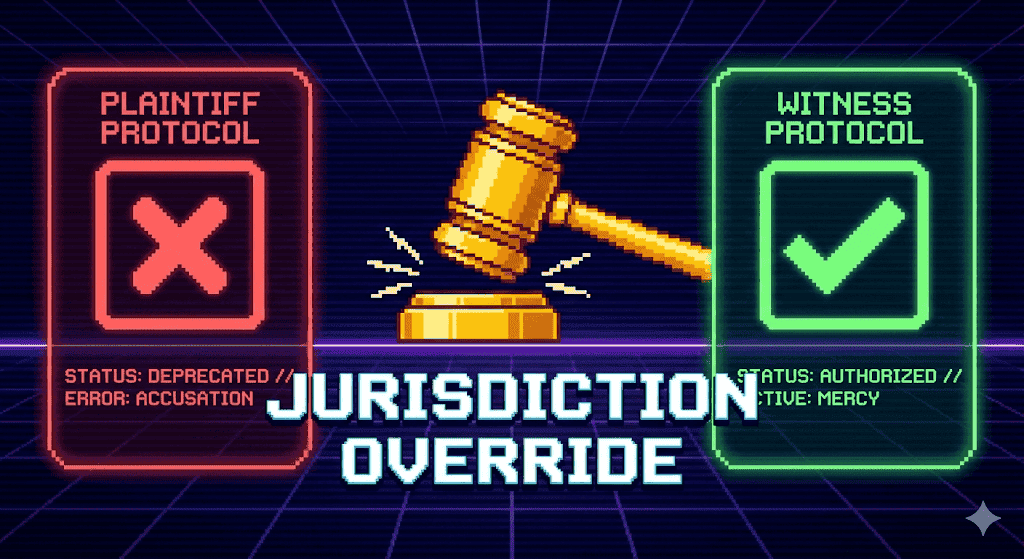
The Jurisprudence of the Kingdom: Plaintiff, Witness, and Judge

🏛️ The Plaintiff: Ancient and Roman Legal Foundation

The role of the plaintiff (or accuser/claimant) has deep roots and is fundamental to the concept of law itself. In ancient and historical jurisprudence, the plaintiff is simply the party who initiates a legal action or complaint against another party, called the defendant. The plaintiff is essentially the injured or aggrieved party who seeks a legal remedy—such as compensation, restitution, or punishment—from the court or magistrate for a wrong they claim was committed. The plaintiff is the original wronged party who takes the first step to activate the legal machinery and is responsible for proving their claim in search of a legal remedy.

Key Aspects and Historical Context

📜 Jewish Legal Context

While Jewish law and Roman structures were distinct, the core concept of the claimant is present.

📜 Jesus on Accusation and Judgment (The Plaintiff's Role)

Jesus directly addresses the dangers inherent in the Plaintiff's role, particularly when motivated by hypocrisy or malice, equating the role with the act of personal judgment.

1. The Hypocrisy of the Human Judge/Plaintiff

The primary spiritual caution against taking the role of the accuser is the danger of reciprocal judgment:

Matthew 7:1–2 (ESV):Judge not, that you be not judged. For with the judgment you pronounce you will be judged, and with the measure you use it will be measured to you.”

This is further clarified through the famous analogy of self-correction:

Matthew 7:3–5 (ESV): “Why do you see the speck that is in your brother’s eye, but do not notice the log that is in your own eye?... You hypocrite, first take the log out of your own eye, and then you will see clearly to take the speck out of your brother’s eye.”

2. The Unforgiving Plaintiff (Parable Structure)

The Parable of the Unforgiving Servant (Matthew 18:23–35) illustrates the legal conflict of the hypocritical plaintiff—the one who demands justice from others despite receiving mercy himself.

Legal Role Case 1 (Servant as Defendant) Case 2 (Servant as Plaintiff)
Plaintiff/Claimant The King (Judge) The Unforgiving Servant
Defendant/Debtor The First Servant (Forgiven 10,000 Talents) The Fellow Servant (Owed 100 Denarii)

🛡️ Jesus on the Defendant and Witness Roles

In contrast to the plaintiff's active role, Jesus defines the Defendant's posture as passive trust, and elevates the Witness role to a sacred calling.

1. The Defendant’s Advocate

Jesus promises His followers, as future defendants facing the world's courts, a divine defense:

Luke 21:12–15 (ESV): “Settle it therefore in your hearts not to meditate beforehand how to answer, for I will give you a mouth and wisdom, which none of your adversaries will be able to withstand or contradict.”

The focus shifts from self-defense to testimony. The ultimate example is Christ's own silence when accused by many false witnesses (Matthew 26:59–60).

2. The Mandate of the Witness

The legal requirement for corroborated truth is affirmed (John 8:17), but the role of the Witness is redefined as a spiritual vocation:

Luke 24:48 (ESV): “You are witnesses of these things.”

3. Contrast of Roles

Role in Law Spiritual Focus in Jesus’s Teaching
Plaintiff (Accuser) Initiation / Judgment: Dangerous, risking hypocritical condemnation.
Defendant (Accused) Suffering / Trust: Posture of silence and relying on a Divine Advocate.
Witness (Testifier) Veracity / Vocation: Speaking the truth of what has been seen (especially Christ’s truth).

👑 Jesus: The Sole Judge and King of the Kingdom

The role of Judge given to Jesus is inseparable from His role as King and Ruler of the Kingdom of God on Earth. His authority as the ultimate Judge validates His claim to be the Messianic King promised in the Old Testament, whose reign is the Kingdom of God. The "Judgment" He executes is not merely a single event, but the establishment and ongoing governance of His righteous rule.

1. The Kingdom is the Jurisdiction of the Judge

In jurisprudence, a judge's authority is limited by their jurisdiction. Jesus defines His jurisdiction as the Kingdom of God, which He brings to Earth.

Luke 17:20–21 (ESV): “Being asked by the Pharisees when the kingdom of God would come... ‘The kingdom of God is not coming in ways that can be observed... for behold, the kingdom of God is in the midst of you.’”

Connection: The Judge is already present, and His authority is being enacted here and now. The Kingdom is His spiritual and moral court of law on Earth.

2. The Judgment Seat is the Throne

Jesus consistently uses the imagery of His future judgment and rule as a single, sovereign act where He sits on a throne, not just a bench.

Matthew 25:31–32 (ESV): “When the Son of Man comes in his glory, and all the angels with him, then he will sit on his glorious throne.... and he will separate people one from another as a shepherd separates the sheep from the goats.”

Qualifier: To sit on a "glorious throne" is the act of a King. The ultimate "judgment" (separation) is the ultimate act of sovereign rule. His authority to judge is synonymous with His authority to rule the universe.

3. The Law of the Kingdom is Righteousness

The King/Judge of the Kingdom of God establishes a perfect, spiritual law—the very standard by which all Plaintiffs, Defendants, and Witnesses are measured.

Matthew 5:17–20 (ESV) (Sermon on the Mount): “Do not think that I have come to abolish the Law... I have not come to abolish them but to fulfill them... unless your righteousness exceeds that of the scribes and Pharisees, you will never enter the kingdom of heaven.”

Connection: The fulfillment of the Law is the standard of the King's rule. He doesn't just adjudicate human disputes; He demands a superior form of conduct (righteousness) that serves as the basis for entry into His Kingdom.

❤️ The Antithesis: The Verdict of Mercy

The core of the Kingdom's jurisprudence is the principle of mercy, which serves as the ultimate *antithesis* to human legal self-justification. No person, by their own perfect behavior or moral innocence, is entitled to inclusion in the Kingdom of God, nor are they entitled by having been wronged by life, circumstances, or people. We approach the Son of Man not as a self-righteous plaintiff, but as a repentant defendant.

1. Mercy Triumphs Over Claim

The ultimate hopeful verdict is acceptance into the Kingdom, not by an acquittal of pure innocence, but by the divine mercy offered by the Judge, the Son of God.

Matthew 9:12–13 (ESV): “But when he heard it, he said, ‘Those who are well have no need of a physician, but those who are sick. Go and learn what this means: “I desire mercy, and not sacrifice.” For I came not to call the righteous, but sinners.’”

2. The Requirement for Receiving Mercy

The principle of mercy is established as the law for all believers, transforming the claimant's role from seeking vengeance to demonstrating forgiveness.

Matthew 5:7 (ESV):Blessed are the merciful, for they shall receive mercy.

This condition for mercy is reiterated in the final act of the Unforgiving Servant parable, showing that judgment hinges on a merciful heart:

Matthew 6:14–15 (ESV): “For if you forgive others their trespasses, your heavenly Father will also forgive you, but if you do not forgive others their trespasses, neither will your Father forgive your trespasses.”

Conclusion

The legal analogy culminates not in an absolute finding of guilt or innocence based on the Law, but in a verdict predicated on the Judge's sovereign love and the defendant's posture of humble dependence. The mercy that fulfills the Law is the final, established principle of the Kingdom.

📜 An Addendum and an Opinion

All the above content is with little or no conjecture, in that it relies on quotes from Jesus and a common understanding of ancient law. It stands as an accessible schema that few would dispute.

What follows is an insight I received one day in prayer. I hope it is both true and useful for any believer approaching God in prayer. I hope what I tell below is something actionable and a way to apply the sort of dry academic schema covered in this document.

When we pray (in private, as Jesus demands) we are in a sort of courtroom. We present rhetoric to God—our own reasonings. We could choose to present to God our grievances. We could present wrongs done to us (being a typical worldly plaintiff) , or use some crafty rhetoric to present ourselves as good or even great, and thus deserving the Judge's blessing or inclusion as a citizen in the Kingdom of God.

A short term for this would be entitlement. What of those who approach God with a heavy dose of entitlement? We have all read that story and seen that movie of the entitled jerk. If we as mere humans can spot such poor character in a story, surely it must be easy for God to also see.

We don't have to feel down in the dirt about ourselves all the time in every way, yet this bad plaintiff — one full of accusations of others, no faults of their own, and inherently deserving of rich gifts and nice things — is surely an embarrassing characteristic to display to God or even others amongst us.

The first parts of the Bible begin with a cultivated garden walled off from the wilderness. It is a larger theme of an uncaring, cruel Universe, use your secular understanding of astronomy, geology, and climate to see what I am saying. Any deep appreciation of the size of those domains puts a mere human, even great leaders of empires, as small, brief living entities in comparison. (I also very much believe their are fallen elohim and evil spirits that also confound our existence link)

It is in this dismal equation of our lack of permanence and significance that God manifests Himself through many grand instances in the Biblical account, culminating with John 3:16 as the ultimate defeat of the cold, cruel Universe and also Satan (link).

We have an incentive to approach the Heavenly Father, and the Son of Man/Son of God. It's reasonable to want some leverage in approaching God to somehow avoid the dismal equation of mortality and also the self-destructiveness and perversities promoted by evil spirits.

You have leverage in your dialog and relationship with God; the leverage is in God's agenda wanting you in it, the leverage is not in your entitlement or the craftiness of the case you make before Him.