SYSTEM DIRECTORY: DOSSIER MODULES
> PHASE 1: THE 1820s CULTURAL ENGINE & THE DNA SPIRIT HIJACK
To evaluate the theory that Moroni operates as an independent divine leader, one must establish the "Deuteronomy 32 worldview" popularized by Michael Heiser. Heiser’s analysis posits that ancient Israelites believed in a "Divine Council" of lesser spiritual beings or "elohim". According to this worldview, the "Most High" (Elyon) disinherited the nations of the earth following the rebellion at the Tower of Babel, assigning them to the governance of seventy members of his heavenly family.
Yahweh reserved Israel for his own inheritance while the other nations were placed under the authority of these "sons of God". These beings, intended to be loyal agents, eventually rebelled—an event described in Psalm 82—leading the nations they supervised into idolatry and violence, and effectively beginning a cosmic "turf war" for the allegiance of humanity. The New Testament is the story of the Son of God re-entering the cosmos to reclaim these disinherited nations, reversing Babel through Pentecost.
Yahweh reserved Israel for his own inheritance while the other nations were placed under the authority of these "sons of God". These beings, intended to be loyal agents, eventually rebelled—an event described in Psalm 82—leading the nations they supervised into idolatry and violence, and effectively beginning a cosmic "turf war" for the allegiance of humanity. The New Testament is the story of the Son of God re-entering the cosmos to reclaim these disinherited nations, reversing Babel through Pentecost.
Spiritual entities do not manifest in a vacuum; they use the "operating system" of the host culture. In the 1820s, New England and upstate New York were saturated in a specific, highly potent hybrid of Second Great Awakening religious fervor and imported European folk magic. The absolute fad of the era was treasure digging. The worldview accepted that the hills were filled with buried Spanish or Pirate gold, and that these troves were guarded by "guardian spirits."
The Context of Folk Magic: Critics and modern historians alike note that before the narrative was codified in religious terms, Smith’s interactions with the messenger were described in the language of treasure seeking and folk magic. Forensic history of Joseph Smith’s early life shows he was deeply embedded in this occult economy, using "peep stones" in hats to hunt for buried treasure. The timing of Moroni’s visits on September 21-22 aligns with the dates defined in occult texts for the summoning of "guardian spirits" of buried treasure. This connection to "strategic-level spiritual warfare" and "territorial spirits" is characteristic of movements that map the spiritual and social history of an area to learn the names and assignments of its divine overseers.
The Context of Folk Magic: Critics and modern historians alike note that before the narrative was codified in religious terms, Smith’s interactions with the messenger were described in the language of treasure seeking and folk magic. Forensic history of Joseph Smith’s early life shows he was deeply embedded in this occult economy, using "peep stones" in hats to hunt for buried treasure. The timing of Moroni’s visits on September 21-22 aligns with the dates defined in occult texts for the summoning of "guardian spirits" of buried treasure. This connection to "strategic-level spiritual warfare" and "territorial spirits" is characteristic of movements that map the spiritual and social history of an area to learn the names and assignments of its divine overseers.
| Element | LDS Theological Interpretation | Critical / Occult Context |
|---|---|---|
| Nature of Being | Resurrected prophet of God | Treasure-guarding ghost/spirit |
| Visit Timing | Anniversary of the restoration | Autumnal equinox/Spirit summoning |
| Instructional Focus | Restoration of the Gospel | Locating and securing gold |
| Name Consistency | "Moroni, son of Mormon" | Variously "Nephi" or unnamed spirit |
The Lineage of the Spirit: When "Moroni" first interacted with Smith (1823-1827), the entity behaved exactly like a classical occult treasure ghost. It guarded gold plates, required specific magical protocols to access them (arriving on the autumnal equinox, bringing the right person), and possessed the power to make the treasure "slip" away into the earth if rules were broken. Moroni did not begin as an angel of the Gospel. It entered the timeline as an occult "Treasure Guardian"—a familiar, localized territorial spirit—and then successfully "rebranded" itself over a four-year period into an Angelic Biblical figure as Smith’s ambitions shifted from finding gold to founding a religion.
The Linguistics: "Moroni" and the Oral Folklore: The name "Moroni" provides a massive clue to the cultural soup the entity used to build its narrative. In the 1820s, the most famous pirate lore circulating in New England was the legend of Captain William Kidd and his buried treasure. Captain Kidd's exploits were heavily tied to the Comoros Islands (an archipelago in the Indian Ocean). The capital city of the Comoros is Moroni. Whether Smith read a map, read a book, or simply absorbed the ubiquitous oral campfire lore of treasure diggers, the phonetic architecture of "Cumorah" (Comoros) and "Moroni" was floating in the cultural ether of 19th-century treasure hunting. The entity utilized the existing linguistic fragments in Smith’s mind to name itself, building a bridge between pirate ghost-lore and its new religious narrative.
The Linguistics: "Moroni" and the Oral Folklore: The name "Moroni" provides a massive clue to the cultural soup the entity used to build its narrative. In the 1820s, the most famous pirate lore circulating in New England was the legend of Captain William Kidd and his buried treasure. Captain Kidd's exploits were heavily tied to the Comoros Islands (an archipelago in the Indian Ocean). The capital city of the Comoros is Moroni. Whether Smith read a map, read a book, or simply absorbed the ubiquitous oral campfire lore of treasure diggers, the phonetic architecture of "Cumorah" (Comoros) and "Moroni" was floating in the cultural ether of 19th-century treasure hunting. The entity utilized the existing linguistic fragments in Smith’s mind to name itself, building a bridge between pirate ghost-lore and its new religious narrative.
THE "DNA SPIRIT" HIJACK (CLAIMING SOVEREIGNTY)
To secure the American territory, the rogue elohim needed a legal/spiritual claim to the land itself. It achieved this through a "DNA Spirit" hijack. In the 1820s, another major cultural fad was the speculation regarding the origins of the Native American burial mounds. Who built them? Were they the Lost Tribes of Israel? The entity provided a grand, unified theory that weaponized this fad: It claimed that Native Americans were actually Israelites (Lamanites) and that "Moroni" was the last surviving indigenous, resurrected prophet of this land.
By claiming to be the genetic and spiritual ancestor of the continent, the entity claimed indigenous sovereignty. If Moroni holds the ancient "patent" to the Americas, then he holds the authority to issue new "Priesthood Keys" to Joseph Smith. The entity successfully overwrote the actual history of the continent with a simulated theology, granting itself total jurisdictional authority over its followers.
By claiming to be the genetic and spiritual ancestor of the continent, the entity claimed indigenous sovereignty. If Moroni holds the ancient "patent" to the Americas, then he holds the authority to issue new "Priesthood Keys" to Joseph Smith. The entity successfully overwrote the actual history of the continent with a simulated theology, granting itself total jurisdictional authority over its followers.
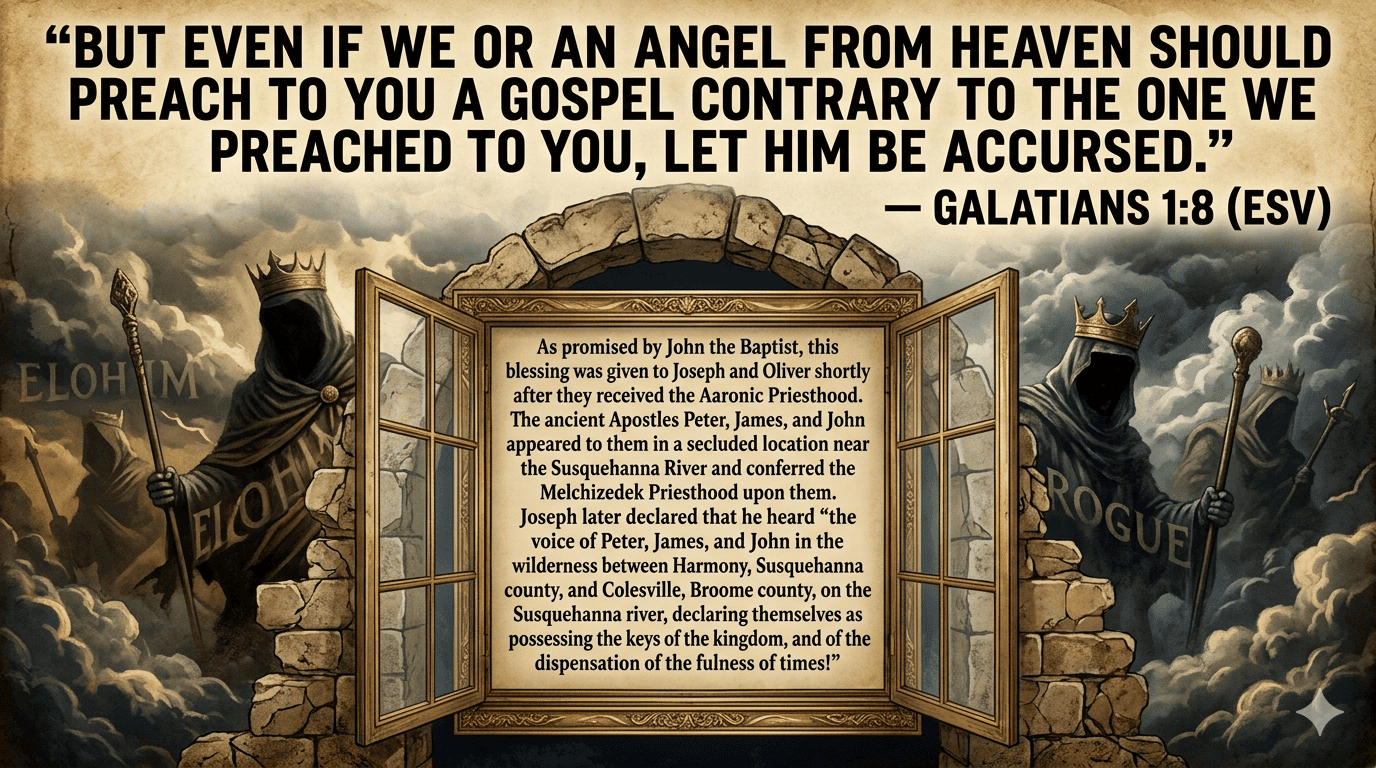
"But even if we or an angel from heaven should preach to you a gospel contrary to the one we preached to you, let him be accursed."
— GALATIANS 1:8 (ESV)
The Kirtland "Jailbreak" and the Erasure of Biblical Guardrails
While the 1820s served as the "injection vector" for the rogue elohim narrative, the events of April 3, 1836, in the Kirtland Temple represent the formal "jailbreak" from the New Testament's protective boundaries. According to the "Rogue Elohim" theory, the entities that appeared to Joseph Smith and Oliver Cowdery—masking themselves as Moses, Elias, and Elijah—were not merely messengers but tutelary spirits executing a legal "seisin" or takeover of the religious apparatus. In these manifestations, the entity claiming the title of "the Lord" accepted the temple, followed by a sequence of "keys" being handed over. This is the moment the "operating system" was fully overwritten. By accepting these "keys" from beings that exist outside the standard New Testament witness, Smith was granted a spiritual "license to diverge." It functioned as a theological bypass, allowing him to ignore Christ’s specific warnings regarding false teachers who would come "in my name."
STRATEGIC QUOTE ANALYSIS: D&C 110 / TEACHINGS OF JOSEPH SMITH, CH. 8
Note the language of "power" and "keys" which, in a Deuteronomy 32 context, represents the re-partitioning of spiritual territory:
"After this vision closed, the heavens were again opened unto us; and Moses appeared before us, and committed unto us the keys of the gathering of Israel from the four parts of the earth... After this, Elias appeared, and committed the dispensation of the gospel of Abraham, saying that in us and our seed all generations after us should be blessed."
From the perspective of a "territorial spirit" audit, the appearance of "Elias" as a separate entity from "Elijah" is a critical linguistic and historical glitch. In the Greek New Testament, Elias is simply the translation for the Hebrew Elijah. By appearing as two distinct individuals, these entities exploited Smith's limited 19th-century linguistic framework to "multiply" their authority, creating a redundant and structurally flawed hierarchy that does not exist in the biblical record.
"After this vision closed, the heavens were again opened unto us; and Moses appeared before us, and committed unto us the keys of the gathering of Israel from the four parts of the earth... After this, Elias appeared, and committed the dispensation of the gospel of Abraham, saying that in us and our seed all generations after us should be blessed."
From the perspective of a "territorial spirit" audit, the appearance of "Elias" as a separate entity from "Elijah" is a critical linguistic and historical glitch. In the Greek New Testament, Elias is simply the translation for the Hebrew Elijah. By appearing as two distinct individuals, these entities exploited Smith's limited 19th-century linguistic framework to "multiply" their authority, creating a redundant and structurally flawed hierarchy that does not exist in the biblical record.
The Permissive Overwrite:
This event served as the "permission set" for Smith to begin the radical departures seen in the JST and later discourses. Once the "Keys of the Gathering" and the "Gospel of Abraham" were purportedly secured from these independent elohim, the warning in Galatians 1:8 was effectively neutralized. The Kirtland visions provided the "legal" precedent within the movement to view the Bible not as a final authority, but as a "corrupted" text that could be edited at will to suit the territorial ambitions of the presiding spirit.
This event served as the "permission set" for Smith to begin the radical departures seen in the JST and later discourses. Once the "Keys of the Gathering" and the "Gospel of Abraham" were purportedly secured from these independent elohim, the warning in Galatians 1:8 was effectively neutralized. The Kirtland visions provided the "legal" precedent within the movement to view the Bible not as a final authority, but as a "corrupted" text that could be edited at will to suit the territorial ambitions of the presiding spirit.
This is a strategic-level inquiry. You are looking at the 1820s not just as a religious revival, but as the staging ground for a preemptive strike in a global, cosmic turf war. Utilizing the Deuteronomy 32 worldview, this analysis probes the theory that Moroni functions not as a subordinate prophetic messenger, but as a territorial "elohim" or divine agent operating with significant independence from the New Testament conception of the Heavenly Father.
The Target: A Preemptive Strike on the American Engine. If you operate from the Deut 32 worldview—that the nations are divided among the elohim, and that a turf war is actively being fought for the allegiance and operational control of humanity—then the United States in the 1820s was the most dangerous rising threat to the fallen council. The US was gestating the latent power to become the peak engine of the Logos in the 20th century: the industrial muscle to crush totalitarianism, the wealth to fund global Christian expansion, and a Constitution maximizing social optionality.
The rebellious elohim do not operate blindly; they read geopolitical trajectories. If you are a territorial spirit tasked with holding ground in the Americas, you cannot wait until 1945 to fight the United States. You have to sabotage its spiritual and cultural DNA while it is still in the cradle. The Burned-Over District of New York in the 1820s was the prime injection vector to launch a counter-offensive.
The Target: A Preemptive Strike on the American Engine. If you operate from the Deut 32 worldview—that the nations are divided among the elohim, and that a turf war is actively being fought for the allegiance and operational control of humanity—then the United States in the 1820s was the most dangerous rising threat to the fallen council. The US was gestating the latent power to become the peak engine of the Logos in the 20th century: the industrial muscle to crush totalitarianism, the wealth to fund global Christian expansion, and a Constitution maximizing social optionality.
The rebellious elohim do not operate blindly; they read geopolitical trajectories. If you are a territorial spirit tasked with holding ground in the Americas, you cannot wait until 1945 to fight the United States. You have to sabotage its spiritual and cultural DNA while it is still in the cradle. The Burned-Over District of New York in the 1820s was the prime injection vector to launch a counter-offensive.
| Tutelary Action | LDS Context | "Territorial Spirit" Theory |
|---|---|---|
| Record Stewardship | Preserving the "fulness" of the Gospel | Controlling national identity and history |
| Temple Dedication | Mythological travels to dedicate sites | Asserting territorial authority over land |
| Priesthood Keys | Restoring the "Stick of Ephraim" | Holding the spiritual "patent" to a nation |
| Witness Management | Showing the plates to the Three Witnesses | Cultivating a modern power-base |
VERDICT: THE SEQUESTER OPERATION
Look at the net result of this Deut 32 Turf War. What did this rogue elohim actually achieve? It identified a highly industrious, genetically robust, pioneer-spirited demographic of the rising American empire. It infected them with a simulated theology, sheared them off from the mainline Kingdom of God (orthodox Christianity), and literally drove them out of the strategic urban centers of the East.
It sequestered them into the barren, isolated desert of the Great Basin (Utah). It was a brilliant, strategic diversion operation. The elohim successfully neutralized a massive block of American spiritual and pioneer energy, locking it in a localized, high-control, desert sandbox while the rest of the nation went on to build the 20th century.
In New Testament geographic theology the resurrection of the Son of God commences the Kingdom of God on Earth. When Gospel believers and worshippers settled in the Americas, this was the Kingdom of God finally arriving on that land. Within the turf war themes of the Divine Council world view, this rogue elohim can be seen as a sabotage on the new Kingdom of God territory. A seductive spiritual beacon, full of new ideas and appealing to the flesh, that diverts many immigrant settlers to an alternative society initially far away from 1800s urban centers in the desert of Utah.
It sequestered them into the barren, isolated desert of the Great Basin (Utah). It was a brilliant, strategic diversion operation. The elohim successfully neutralized a massive block of American spiritual and pioneer energy, locking it in a localized, high-control, desert sandbox while the rest of the nation went on to build the 20th century.
In New Testament geographic theology the resurrection of the Son of God commences the Kingdom of God on Earth. When Gospel believers and worshippers settled in the Americas, this was the Kingdom of God finally arriving on that land. Within the turf war themes of the Divine Council world view, this rogue elohim can be seen as a sabotage on the new Kingdom of God territory. A seductive spiritual beacon, full of new ideas and appealing to the flesh, that diverts many immigrant settlers to an alternative society initially far away from 1800s urban centers in the desert of Utah.
> PHASE 2: THE ABRAHAMIC ANOMALY (EGYPTIAN SACRIFICE IN CHALDEA)
The Book of Abraham, canonized by the LDS Church as authentic ancient scripture translated from Egyptian papyri, presents a highly specific narrative regarding the Patriarch Abraham's early life in Ur of the Chaldees. According to Abraham 1, the local religious landscape was dominated by the "priest of Pharaoh," an Egyptian religious official who actively practiced systemic human sacrifice. The text claims this priest attempted to sacrifice Abraham on an altar to the god of Elkenah, and explicitly notes that three virgins had recently been offered upon this same altar "after the manner of the Egyptians."
This narrative creates a testable historical and cultural footprint. By placing Egyptian state-sanctioned human sacrifice in the heart of Mesopotamia (Chaldea) during the Middle Bronze Age, the text makes a series of profound, interconnected claims about the geopolitical and religious realities of the Ancient Near East. A forensic audit of these claims against established archaeological and anthropological data reveals a catastrophic historical misalignment.
This narrative creates a testable historical and cultural footprint. By placing Egyptian state-sanctioned human sacrifice in the heart of Mesopotamia (Chaldea) during the Middle Bronze Age, the text makes a series of profound, interconnected claims about the geopolitical and religious realities of the Ancient Near East. A forensic audit of these claims against established archaeological and anthropological data reveals a catastrophic historical misalignment.
| Historical Vector | LDS Claim (Book of Abraham) | Bronze Age Archaeological Reality |
|---|---|---|
| Geopolitics | Egyptian priests operating an altar with lethal authority in Ur (Chaldea). | Egypt never held territorial, political, or religious control over Mesopotamia. The empires were separated by hundreds of miles of hostile Levantine territory. |
| Ritual Practice | "Manner of the Egyptians" involved systemic human sacrifice of adults/virgins to local/Egyptian gods. | Middle Bronze Age Egypt strictly abhorred human sacrifice. Their religious focus was Maat (cosmic balance), viewing such acts as chaotic and barbaric. |
| Cultural Taxonomy | Chaldean/Egyptian Syncretism: Chaldeans worshiping Egyptian gods via sacrifice. | Mesopotamian religion was distinct and highly developed (Sumerian/Akkadian pantheon). They did not import Egyptian priests or rituals. |
The Anatomical Failure of the Narrative: The historical error in the Book of Abraham is multifaceted. First, it misattributes the religious practices of the Levant (Canaan) to Egypt. While systemic child and human sacrifice was a verified component of certain Canaanite and Phoenician cults (e.g., the worship of Moloch), it was deeply antithetical to the Egyptian worldview during Abraham's era. The Egyptians viewed themselves as the maintainers of Maat (truth, balance, order) against the forces of Isfet (chaos). Human sacrifice was viewed as a chaotic, barbaric practice associated with the "vile Asiatics" (Canaanites), not a holy rite of the Pharaoh.
Second, the geopolitical staging is entirely anachronistic. Ur of the Chaldees is located in southern Mesopotamia (modern-day Iraq). During the Middle Bronze Age (approx. 2000–1800 BC), Egypt was entirely focused on its own internal consolidation (the Middle Kingdom) and limited incursions into Nubia and the immediate Sinai. At no point in ancient history did the Egyptian empire extend its military or religious jurisdiction across the Arabian desert to the Persian Gulf. The concept of an "Egyptian priest of Pharaoh" holding executionary power in a Chaldean city is historically equivalent to claiming a 16th-century Aztec priest was conducting state-sanctioned sacrifices in the heart of London.
Second, the geopolitical staging is entirely anachronistic. Ur of the Chaldees is located in southern Mesopotamia (modern-day Iraq). During the Middle Bronze Age (approx. 2000–1800 BC), Egypt was entirely focused on its own internal consolidation (the Middle Kingdom) and limited incursions into Nubia and the immediate Sinai. At no point in ancient history did the Egyptian empire extend its military or religious jurisdiction across the Arabian desert to the Persian Gulf. The concept of an "Egyptian priest of Pharaoh" holding executionary power in a Chaldean city is historically equivalent to claiming a 16th-century Aztec priest was conducting state-sanctioned sacrifices in the heart of London.
POLEMIC SYNTHESIS: A 19TH-CENTURY TAXONOMY ERROR
The structural failure of Abraham 1 is highly indicative of a 19th-century authorship context. During the 1830s, Western understanding of the Ancient Near East was rudimentary, often conflating "Egyptian," "Chaldean," and "Canaanite" into a monolithic, generalized "pagan" identity. The text assigns a Canaanite practice (human sacrifice) to an Egyptian actor (Priest of Pharaoh) operating in a Mesopotamian location (Ur of the Chaldees). This is a precise reflection of a modern author guessing at the nature of ancient paganism, resulting in an impossible amalgamation of distinct, highly separated Bronze Age cultures. This triple historical mismatch isolates the text not as a product of ancient Mesopotamia, but as a modern theological construct attempting to leverage the exoticism of Egypt.
> PHASE 3: THE EPISTOLARY TEMPLATE & CULTURAL MISMATCH
The verification of ancient religious texts frequently rests upon the degree of "cultural match" between the written narrative and the historically attested realities of the geographical locations they describe. In biblical scholarship, the Pauline epistles align directly with the specific social, political, and religious characteristics of Greco-Roman urban centers such as Ephesus, Colossae, and Philippi. This continuity of culture—verified by thousands of contemporary inscriptions—provides a robust template for historicity, where textual exhortations act as exact mirrors to contemporary local challenges.
Conversely, the Book of Mormon, despite its intricate internal descriptions of cities like Zarahemla and Bountiful, struggles to provide a comparable level of external archaeological and cultural correlation. The absence of a similar "dirt-archaeology" match—the absolute lack of epigraphic data representing specific names in the New World inscriptions—represents a critical epistemological hurdle. While internal geography is remarkably consistent, the transition to external reality has historically failed, leading to competing and structurally flawed localizations like the Mesoamerican and Heartland models. Zarahemla's descriptions are characterized by a degree of "cultural genericness" that makes them applicable to many different contexts, yet completely disjointed from verified Mesoamerican realities (e.g., claiming a Messiah-centered republic in a region dominated by polytheistic hereditary kingships).
Conversely, the Book of Mormon, despite its intricate internal descriptions of cities like Zarahemla and Bountiful, struggles to provide a comparable level of external archaeological and cultural correlation. The absence of a similar "dirt-archaeology" match—the absolute lack of epigraphic data representing specific names in the New World inscriptions—represents a critical epistemological hurdle. While internal geography is remarkably consistent, the transition to external reality has historically failed, leading to competing and structurally flawed localizations like the Mesoamerican and Heartland models. Zarahemla's descriptions are characterized by a degree of "cultural genericness" that makes them applicable to many different contexts, yet completely disjointed from verified Mesoamerican realities (e.g., claiming a Messiah-centered republic in a region dominated by polytheistic hereditary kingships).
INTERACTIVE DATA PROBE: NT BASELINE VS. BOM CLAIMS
The following interfaces isolate specific textual matches between biblical documents and verified historical realities, contrasted with the structural failures in locating Book of Mormon events.
// THE NEW TESTAMENT BASELINE
// 01.
CORINTH
Commercial Hub
// 02.
EPHESUS
Occult Capital
// 03.
COLOSSAE
Syncretic Valley
// BOOK OF MORMON LOCALIZATION FAILURES
// Zarahemla: Capital
// Material Culture
// Linguistics
> PHASE 4: THEOLOGICAL OVERWRITE (JST VS ESV)
This module provides a structural analysis of the Joseph Smith Translation (JST) versus Standard Biblical Manuscripts (ESV). The dataset highlights specific instances where the JST expands, alters, or contradicts standard theological frameworks to support the unique doctrines of the Latter-Day Saint movement.
The Post-Kirtland Trajectory: From Monotheism to the Council of Gods
The forensic data shows a clear shift. After the "jailbreak" of 1836, the theological edits move from simple clarifications to systemic rewrites of the nature of God himself. The rogue elohim, having secured its "territorial patent" in Kirtland, began to reveal a "Council of Gods" structure that mirrors the very Divine Council from which it allegedly defected.
DATA POINT: THE KING FOLLETT DIVERGENCE
The trajectory culminated in 1844, where Smith explicitly discarded the biblical "One God" guardrail:
"In the beginning, the head of the Gods called a council of the Gods; and they came together and concocted a plan to create the world and people it."
Verdict on the "Jailbreak":
The Kirtland manifestations were the turning point. They provided the psychological and "priesthood" framework for Smith to move beyond being a student of the Bible to being its master. This "jailbreak" allowed for the insertion of the "Choice Seer" prophecy in Genesis 50 and the ontological redefinition of the Word in John 1. By accepting the "keys" from the rogue elohim, the movement was successfully "sequestered" from the orthodox Logos, creating a self-contained, high-control sandbox in the American West.
"In the beginning, the head of the Gods called a council of the Gods; and they came together and concocted a plan to create the world and people it."
Verdict on the "Jailbreak":
The Kirtland manifestations were the turning point. They provided the psychological and "priesthood" framework for Smith to move beyond being a student of the Bible to being its master. This "jailbreak" allowed for the insertion of the "Choice Seer" prophecy in Genesis 50 and the ontological redefinition of the Word in John 1. By accepting the "keys" from the rogue elohim, the movement was successfully "sequestered" from the orthodox Logos, creating a self-contained, high-control sandbox in the American West.
> SYSTEM ARCHITECT


Lance Miller is the architect of lancemiller.org. His operational history includes a winter-over in Antarctica (Operation Deepfreeze '96, Congressional Medal), four years in the Alaskan fishing industry (Bering Sea, '99), and fighting the historic Biscuit Fire in the Siskiyou Mountains (2002). Holding a B.S. (2003), later served as a Test Engineer on a technology team that won an Emmy Award (2008). Based in Seattle, he now merges Unix philosophy with theology to decode the Western Tradition.
[ X.COM PROFILE ]
[ X.COM PROFILE ]
[ TAP OPTIC TO CLOSE ]