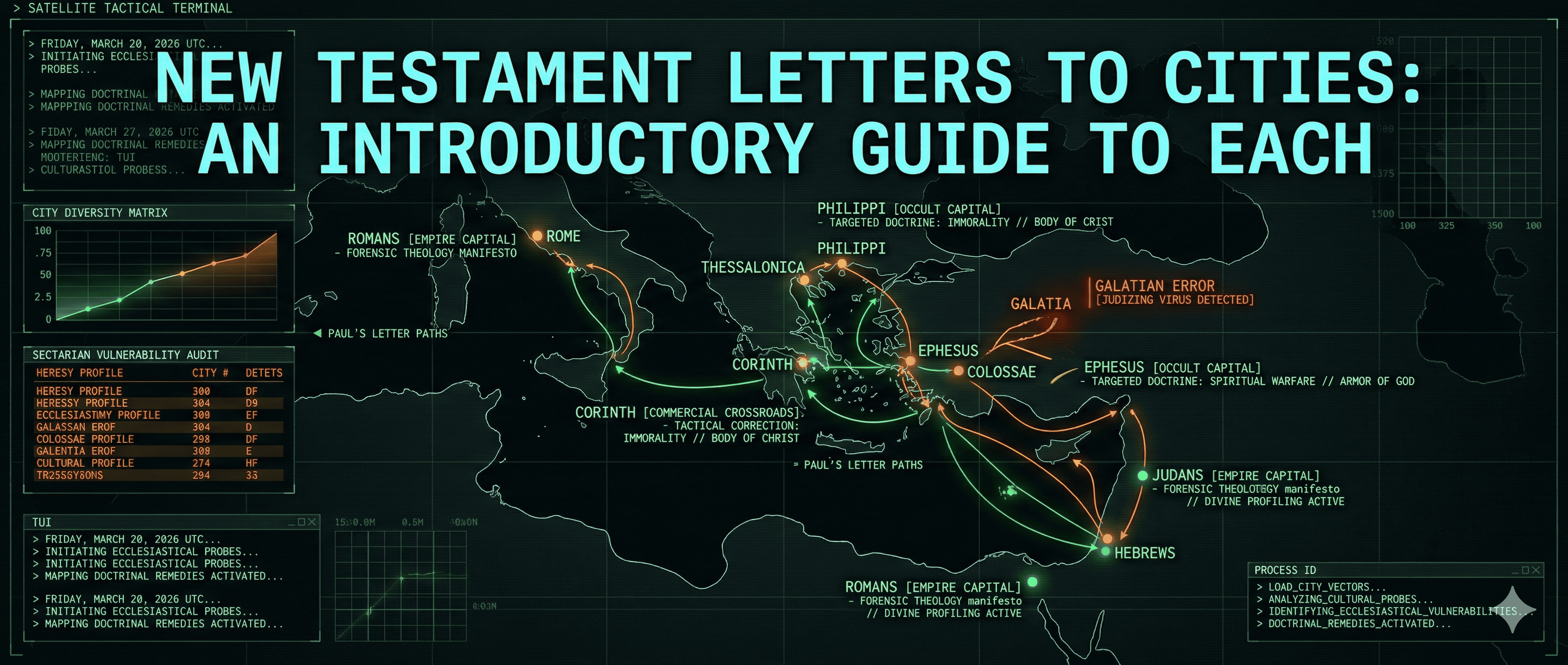
PROJECT OVERVIEW:
This research provides a systematic probe of the New Testament books named after cities (and the requested exceptions), following the standard ESV canon. Each section analyzes the historical and cultural profile of the location/group and how the specific Letter addresses those unique elements.
// 1. Romans (The Exception: Capital of the Empire)
Culture and History: 1st-century Rome was the cosmopolitan heart of the world, with a population of nearly one million. It was a melting pot of Latin, Greek, and Near Eastern ethnicities. The Jewish community was significant (estimated 40,000–50,000) but had been recently destabilized by the Edict of Claudius (AD 49), which expelled Jews from the city.
Ethnicity: A tension-filled mix of Gentile (mostly Roman and Greek) and Jewish believers.
Ethnicity: A tension-filled mix of Gentile (mostly Roman and Greek) and Jewish believers.
THE LETTER CONNECTION
Because the Roman church was not founded by Paul and was struggling with the return of Jewish believers after their exile, the Letter is a "theological manifesto." Paul systematically addresses the equal standing of Jew and Gentile:
"For there is no distinction between Jew and Greek; for the same Lord is Lord of all" (Romans 10:12).
It serves as a diplomatic and doctrinal bridge to unify a divided urban church.
// 2. Corinthians (Corinth: The Commercial Crossroads)
Culture and History: Corinth was a wealthy, "new money" Roman colony rebuilt by Julius Caesar. Located on an isthmus, it controlled two major ports, making it a hub for global trade, sailors, and transient merchants. It was notorious for its immorality; the Greek term korinthiazomai meant "to live like a Corinthian" (i.e., in debauchery).
Ethnicity: Highly diverse—Italians, Greeks, Jews, and Levantines.
Ethnicity: Highly diverse—Italians, Greeks, Jews, and Levantines.
THE LETTER CONNECTION
The chaos of the city bled into the church. Paul addresses "lawsuits among believers," "sexual immorality," and "disorder at the Lord's Supper." His famous discourse on love (1 Corinthians 13) and the "body of Christ" (chapter 12) was a direct counter-culture to the competitive, status-seeking, and individualistic nature of Corinthian society.
// 3. Galatians (The Ethnic Exception: The Region of the Celts)
Culture and History: This region in Central Anatolia was settled by migrant Celtic tribes (Gauls) in the 3rd century BC. They were known for being fierce, impulsive, and deeply religious, later Hellenized but retaining a distinct "Gallic" temperament.
Ethnicity: Primarily Celtic-descended Galatians with a minority of Greek and Jewish settlers.
Ethnicity: Primarily Celtic-descended Galatians with a minority of Greek and Jewish settlers.
THE LETTER CONNECTION
Paul's tone is uniquely sharp because the Galatians were being quickly "bewitched" by legalism. The struggle was between their ancestral paganism and "Judaizing" teachers. Paul emphasizes liberty:
"For freedom Christ has set us free" (Galatians 5:1)
...appealing to a people historically defined by their independence and distinct ethnic identity.
// 4. Ephesians (Ephesus: The Occult Capital)
Culture and History: Ephesus was the "First and Greatest Metropolis of Asia." It was home to the Temple of Artemis, one of the Seven Wonders of the Ancient World. The city was a center for the "Ephesian Letters" (magic scrolls) and deep-seated occult practices.
Ethnicity: Primarily Greek and Roman, with a strong presence of magical-cult practitioners.
Ethnicity: Primarily Greek and Roman, with a strong presence of magical-cult practitioners.
THE LETTER CONNECTION
Because the city was steeped in spiritual warfare and the "occult," Paul uses heavy "power language." He speaks of Christ being far above all "rule and authority and power and dominion" (Ephesians 1:21). The letter concludes with the famous "Armor of God" (Ephesians 6), providing a spiritual defense for believers living in the shadow of the world’s most famous pagan temple.
// 5. Philippians (Philippi: "Little Rome")
Culture and History: Philippi was a Roman colony in Macedonia, settled largely by retired Roman soldiers. It was granted Ius Italicum, meaning the city was legally considered a piece of Italian soil. The citizens were fiercely proud of their Roman citizenship.
Ethnicity: Heavily Romanized Greeks and retired military veterans.
Ethnicity: Heavily Romanized Greeks and retired military veterans.
THE LETTER CONNECTION
Paul plays on their civic pride by reminding them:
"But our citizenship is in heaven" (Philippians 3:20).
He uses military-esque language about "standing firm" and "contending as one man," reflecting the disciplined, patriotic culture of a Roman military colony.
// 6. Colossians (Colossae: The Syncretistic Valley)
Culture and History: A smaller city in the Lycus Valley, known for its wool industry. It was in decline compared to its neighbors, Laodicea and Hierapolis. The culture was highly syncretistic—mixing Phrygian nature-worship, Greek philosophy, and Jewish mysticism.
Ethnicity: A blend of native Phrygians, Greeks, and a Jewish minority.
Ethnicity: A blend of native Phrygians, Greeks, and a Jewish minority.
THE LETTER CONNECTION
To combat "The Colossian Heresy" (a mix of angel worship and asceticism), Paul emphasizes the absolute Supremacy of Christ. He asserts that Christ is the "image of the invisible God" and that in Him "all things hold together" (Colossians 1:15-17), directly refuting the local tendency to seek "intermediary" spiritual beings or secret knowledge.
// 7. Thessalonians (Thessalonica: The Political Hub)
Culture and History: A "Free City" and the capital of the province of Macedonia. It was located on the Via Egnatia, the main highway of the Empire. Because of its "Free City" status, the local leaders (politarchs) were extremely sensitive to any hint of insurrection against Caesar.
Ethnicity: Macedonian Greeks, Romans, and a vocal Jewish community.
Ethnicity: Macedonian Greeks, Romans, and a vocal Jewish community.
THE LETTER CONNECTION
The charge against Paul in Acts 17 was that he was proclaiming "another king, Jesus." Consequently, 1 & 2 Thessalonians are saturated with "Kingship" and "Second Coming" (Parousia) language. Paul encourages them to endure persecution by focusing on the return of the true King, which directly contrasted with the city's political loyalty to the Emperor.
// 8. Hebrews (The Exception: The Displaced Remnant)
Culture and History: "Hebrews" refers to a group rather than a city, likely Jewish Christians perhaps in Rome or Jerusalem. They were facing "social death"—loss of property, imprisonment, and exclusion from the Temple and synagogue life.
Ethnicity: Exclusively Jewish (2nd generation believers).
Ethnicity: Exclusively Jewish (2nd generation believers).
THE LETTER CONNECTION
The culture was one of intense pressure to "return" to the safety of the Old Covenant rituals to avoid persecution. The author uses a systematic, "better than" argument: Jesus is better than angels, Moses, and the Aaronic priesthood. The letter serves as an ethnic and spiritual "anchor" for a people losing their earthly cultural heritage for a heavenly one.
> SYSTEM ARCHITECT




Lance Miller is the architect of lancemiller.org. His operational history includes a winter-over in Antarctica (Operation Deepfreeze '96, Congressional Medal), four years in the Alaskan fishing industry (Bering Sea, '99), and fighting the historic Biscuit Fire in the Siskiyou Mountains (2002). Holding a B.S. (2003), he later served as a Test Engineer on a technology team that won an Emmy Award (2008). Based in Seattle, he now merges Unix philosophy with theology to decode the Western Tradition.
[ X.COM PROFILE ]
[ X.COM PROFILE ]
[ TAP OPTIC TO CLOSE ]