OPERATIONAL CONTEXT:
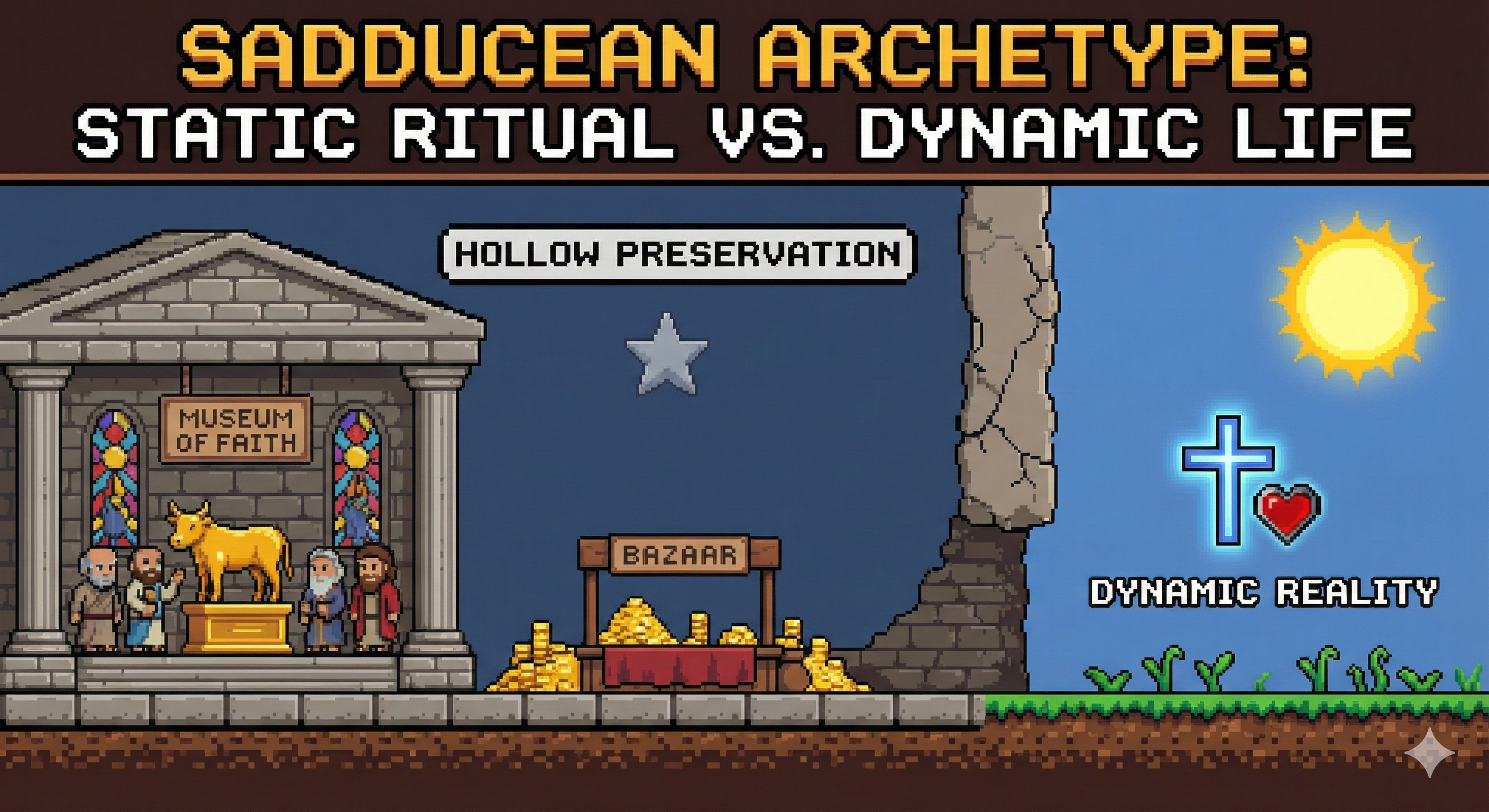
To understand the mission of Jesus, you must identify His primary kinetic opponent. While Satan is the spiritual adversary, the Sadducees were the physical mechanism of opposition. They were the "Secular Custodians" of the faith—controlling the Temple while denying the supernatural power that gave it meaning.
"But Jesus remained silent. And the high priest said to him, 'I adjure you by the living God, tell us if you are the Christ, the Son of God.' Jesus said to him, 'You have said so. But I tell you, from now on you will see the Son of Man seated at the right hand of Power and coming on the clouds of heaven.'"
Matthew 26:63-64 (ESV)
THE BINARY LOGIC GATE:
This moment is the fulcrum of history. Jesus refused to answer the false witnesses (see
Kingdom Jurisprudence), maintaining silence against procedural errors. But when the High Priest (Caiaphas, a Sadducee) demanded a direct identity claim, Jesus answered.
The Logic Flow:
1.
IF Jesus is just a man claiming divinity,
THEN the Sadducees are righteous defenders of the faith for executing a heretic.
2.
IF Jesus is the Son of God,
THEN the Sadducees are at war with YHWH Himself.
The Proof of Work: The only way to resolve this logic gate is the
Resurrection. A dead Messiah proves the Sadducees right. A living, breathing, eating, touchable resurrected Messiah proves them dead wrong.
This is why the Resurrection had to be
physical. Smoke, mirrors, and "spiritual visions" are easily dismissed by materialists. A man eating fish with holes in his hands (Luke 24:41-43) destroys the Sadducean worldview.
"You are wrong, because you know neither the Scriptures nor the power of God."
Matthew 22:29 (ESV)
PATTERN RECOGNITION:
The Sadducean Spirit is alive today in
Secular Custodialism.
It manifests in churches that maintain the
architecture and
liturgy of the faith but deny the
power of the Resurrection and the authority of the Text. They treat the church as a cultural heritage site (Museum) or a social service agency (NGO), but recoil at the idea of a dangerous, intervening God who judges nations and demands repentance.
See also:
The Political Firewall regarding modern Liberation Theology.
SYSTEM PURGE:
In 70 AD, the Roman Legions breached Jerusalem and burned the Temple.
Theological Significance: The Sadducees ceased to exist instantly. Why? Because their god was the building. Without the Temple apparatus, they had no function, no revenue, and no theology.
The Pharisees survived because they had the Text (Torah/Oral Law) which could travel. The Christians survived because they had the Spirit (The Indwelling Temple). The Sadducees, who trusted in walls and gold, were erased from history.